> For the complete documentation index, see [llms.txt](https://specs.govstack.global/llms.txt). Markdown versions of documentation pages are available by appending `.md` to page URLs; this page is available as [Markdown](https://specs.govstack.global/implementation-playbook/introduction/get-an-overview-on-the-implementation-process.md).
# Get an Overview on the Implementation Process
This chapter outlines a high-level overview of the Implementation section of the Playbook. It introduces the structure, phases, and underlying logic of the GovStack implementation approach.
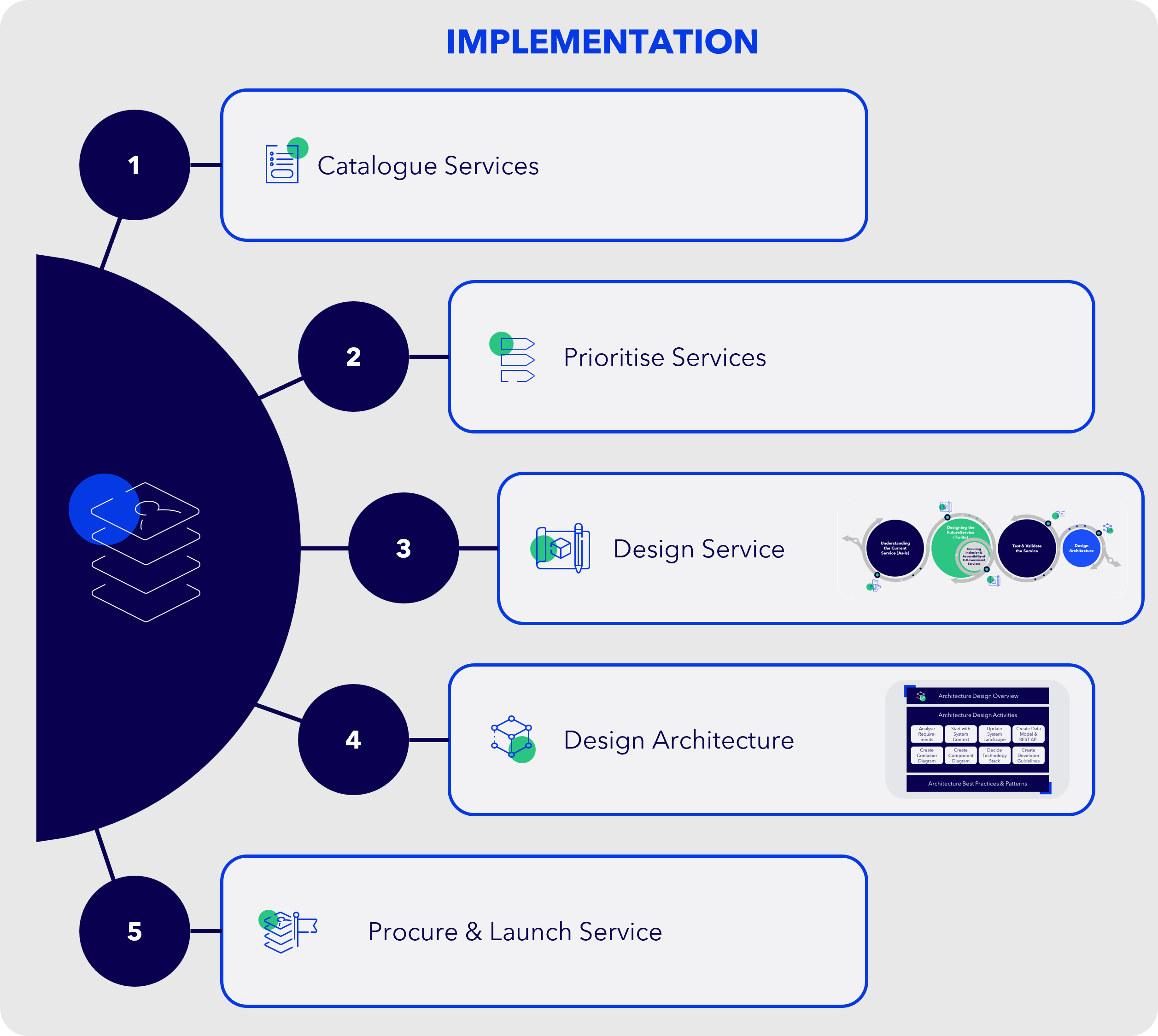
The Implementation section itself sets out a structured, step-by-step approach to implementing a digital public service using GovStack's core principles and reusable Building Blocks. It guides you through the key phases required to design, build, launch, and sustain a citizen-centric and scalable service.
While the phases are presented in a logical sequence, implementation activities may occur iteratively or in parallel depending on your context. You may enter the process at the stage most relevant to your project's maturity. Each phase outlines its purpose, key activities, expected outputs, and its contribution to delivering a coherent and sustainable digital public service.
### Step-by-step implementation
{% stepper %}
{% step %}
### Catalogue services
You begin by creating a clear inventory of existing services. This will help you understand the current landscape, identify gaps and discover areas where digitalization can add the most value.
{% endstep %}
{% step %}
### Prioritise services
In this step, you proritise which services must be developed. The service will be selected based on a transparent rationale, considering metrics such as user value, feasibility, impact, and alignment with national or organizational priorities.
{% endstep %}
{% step %}
### Design service
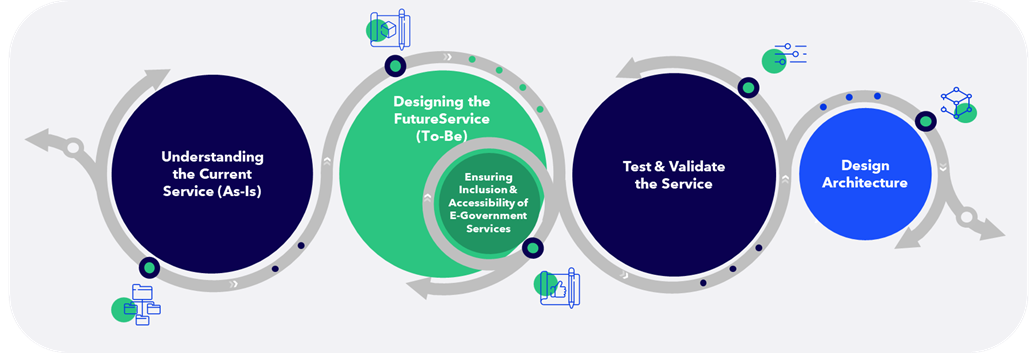
This step guides you to design a digital public service that is user-centric, inclusive and futureproof. It contains four steps, as mentioned below, that allow you to gain deep understanding of the current service journey, problems, and user needs. Further, it outlines how to define future service, collect evidence from user testing and to validate the service. More importantly, this section guides you to design a service that embeds inclusion and accessibility principles from the start. Please note that each of these four steps are explained in detail in their respective chapters.
* Understanding the Current Service (As-Is)
* Designing the Future Service (To-Be)
* Testing and Validating the Service
* Ensuring Inclusion and Accessibility of E-Government Services
{% endstep %}
{% step %}
### Design architecture
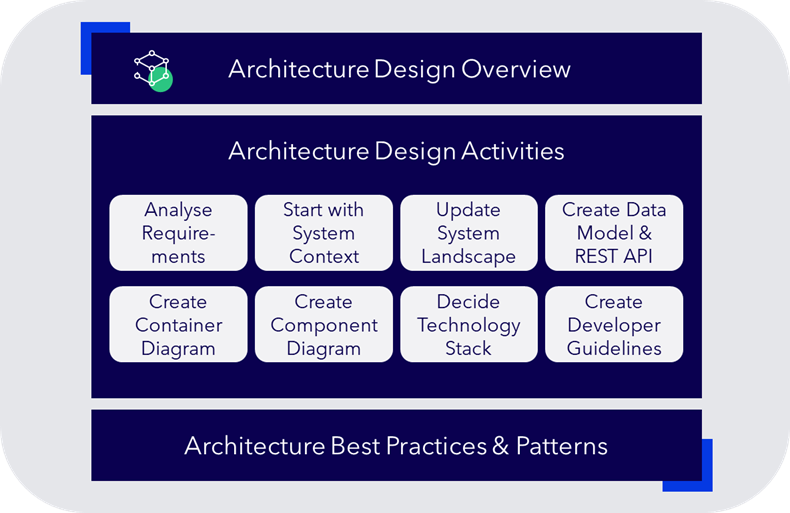
Here, you will learn how to build a coherent system architecture that aligns with your service design. In this section, you will find how to design the technical foundation needed to support your service, including integrations, data models and technical standards. By the end of this section, you will be able to create developer-ready guidelines to support implementation of the selected service. The “Design Architecture” chapter explains in detail the processes and activities, and best practices for architecture planning in their respective sections.
* Architecture Design Overview
* Process Description & Activities for Architecture Planning
* Best Practices & Patterns for Architecture Planning
{% endstep %}
{% step %}
### Develop and launch service
The final phase of the Implementation section provides support to turn your service design and architecture into a working solution. By working through this chapter, you will learn to cho
ose software and service providers for your service delivery and create a development plan that aligns with the design and architecture of your service. Furthermore, at the end of the section, you will be fully equipped to successfully launch your service and develop a continuous maintenance and improvement plan.
This part of the section further explains the following steps:
* Selecting Software and Service Providers
* Software Development Cycle
* Infrastructure Architecture
* Launching the Service
* Maintaining
{% endstep %}
{% endstepper %}
This chapter provided an overview of the GovStack implementation process, describing the sequence of phases and how they relate to each other in developing and operating a digital public service. The following chapters build on this overview and examine each phase in detail, offering practical guidance, activities, and expected outcomes.
---
# Agent Instructions
This documentation is published with GitBook. GitBook is the documentation platform designed so that both humans and AI agents can read, navigate, and reason over technical content effectively. Learn more at gitbook.com.
## Querying This Documentation
If you need additional information that is not directly available in this page, you can query the documentation dynamically by asking a question.
Perform an HTTP GET request on the current page URL with the `ask` query parameter, and the optional `goal` query parameter:
```
GET https://specs.govstack.global/implementation-playbook/introduction/get-an-overview-on-the-implementation-process.md?ask=&goal=
```
`ask` is the immediate question: it should be specific, self-contained, and written in natural language.
`goal` is optional and describes the broader end goal you are ultimately trying to accomplish on behalf of the user. GitBook uses it to tailor the answer towards what is most useful for that goal.
The response will contain a direct answer to the question and relevant excerpts and sources from the documentation.
Use this mechanism when the answer is not explicitly present in the current page, you need clarification or additional context, or you want to retrieve related documentation sections.