# Catalogue Services

Government services are often distributed across numerous websites, presented inconsistently, and difficult to understand.

Changing this requires two core components:

* The service catalogue: This provides the content basis and answers questions such as: What services are available and how are they structured?
* The One-Stop Shop: This describes how the service catalogue is presented to users (i.e. the user interface) and answers questions such as: Where can citizens access all services at a glance?

Both elements are inherently connected. While the service catalogue defines the content and structure of government services, the One-Stop Shop is the user interface that presents services in a consistent and an easily accessible manner.

## Catalogue services

A government digital service catalogue is an online platform or database that provides information about various digital services and resources offered by a government to its citizens, businesses, and other stakeholders. The service catalogue can be made available to users with a consistent/unified user experience.

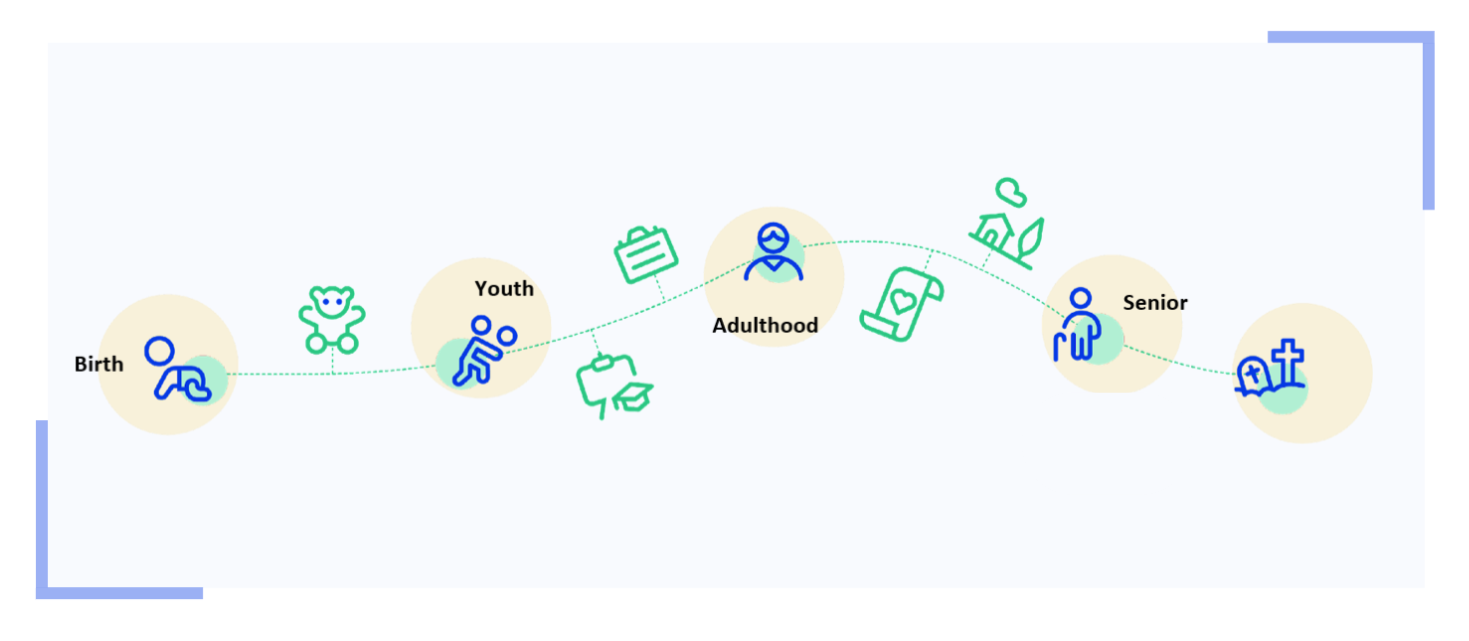
No service lives in a vacuum, thus it is important to understand how they fit together to impact the overall user experience. This interplay of services based on the life events that trigger their need can be mapped using the [User/Business Life event map](https://miro.com/app/board/uXjVOiQif00=/?share_link_id=816348815953). Once the services are mapped, they can be further analyzed to understand the level of their digital maturity and potential for simplification.

<figure><img src="https://content.gitbook.com/content/AjfvR3V09S9HmlHskZ6N/blobs/2WhVcKOl3Hr8fCxB0Tmn/life%20events.png" alt=""><figcaption><p>Go to <a href="https://miro.com/app/board/uXjVOiQif00=/?share_link_id=431542248103">User/Business life events template</a></p></figcaption></figure>

### Service patterns

As the service catalogue serves as a structured and comprehensive directory of government services, a consistent approach is needed to ensure the consistency of all entries.

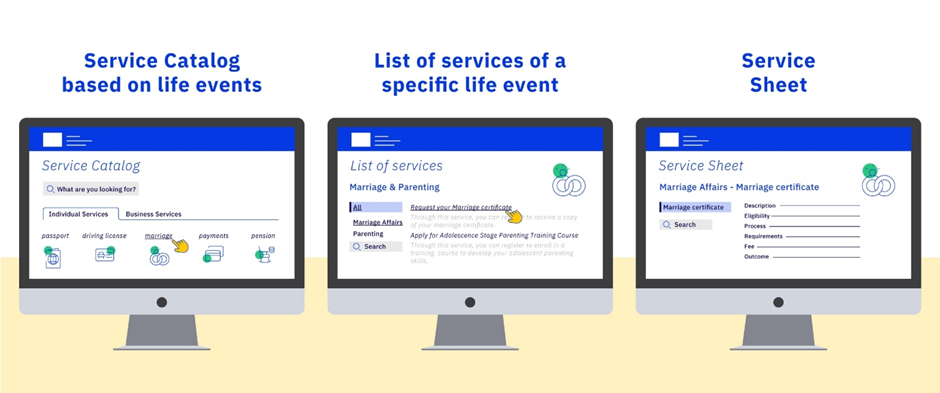
Service patterns provide a consistent structural logic that allows services in the catalogue to be organized, compared, and maintained using shared, repeatable components. They enable governments to standardize how services are described and delivered, ensuring the catalogue remains coherent, scalable, and easy to navigate for both administrators and end users.

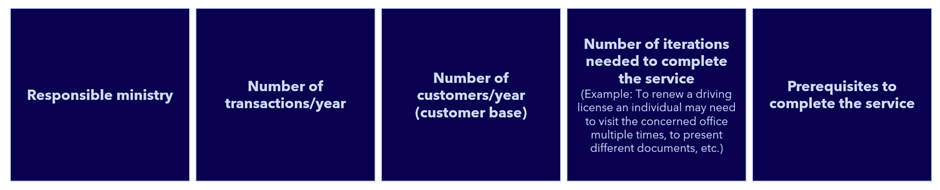
<figure><img src="https://content.gitbook.com/content/AjfvR3V09S9HmlHskZ6N/blobs/CE6S8LrkdGiDGNFl4hre/image.png" alt=""><figcaption><p>Example of a service pattern in a service catalogue</p></figcaption></figure>

Further detailed information about Service Patterns can be found here: [Service catalogue | Service Patterns | GovStack Specification](https://specs.govstack.global/service-patterns/3.-step-patterns/service-catalogue)

## One-Stop Shop

Information about government services is often complicated to access and understand for citizens. The lack of homogeneity in location, format, language, and level of detail leads to insufficient clarity regarding the actions and procedures that users must follow to access the services.

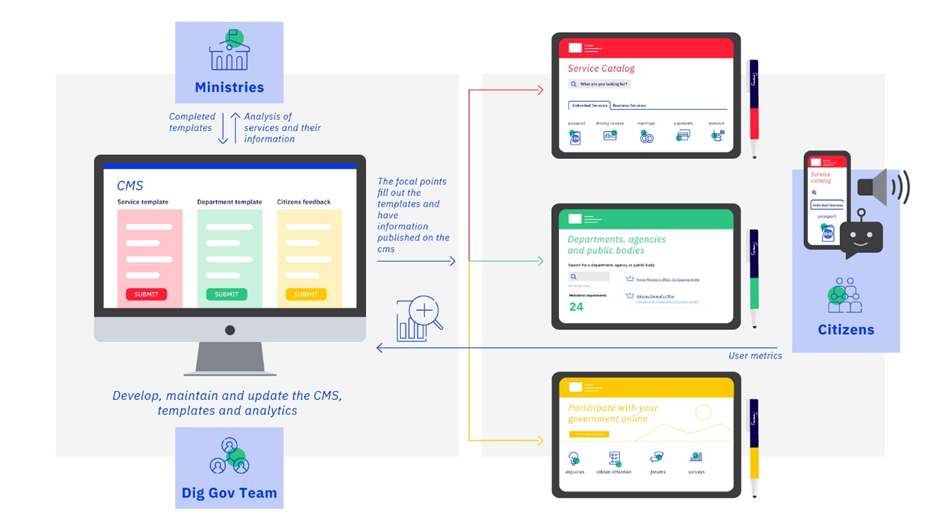
A citizen/business One-Stop Shop facilitates access to information on government services, entities, and citizen participation mechanisms among other resources in one place in a user-centric way.

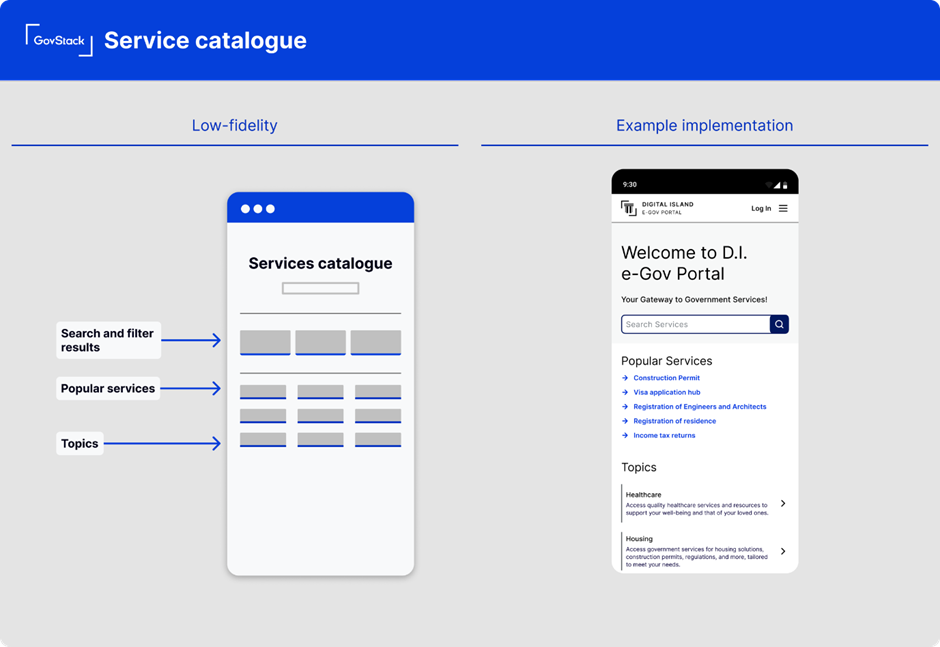
<figure><img src="https://content.gitbook.com/content/AjfvR3V09S9HmlHskZ6N/blobs/oroujorAaySEKwt0ll0V/image.png" alt=""><figcaption><p>Representation of a service catalogue under a citizen/business One-Stop Shop</p></figcaption></figure>

<details>

<summary>How does a good citizen/business One-Stop Shop benefit its users?</summary>

It allows its user to easily:

* Find the service/information they need by identifying the event that triggered the need. Example: Registering a newborn
* Find the required information and actions to obtain the service
* Understand the provided information and actions without any assistance
* Obtain services in a uniform, simple, standardized way
* Seek support from competent authority when needed

</details>

<details>

<summary>How does a good citizen/business One-Stop Shop benefit digital teams?</summary>

A good citizen/business One-Stop Shop allows:

* Analysis of the entire catalogue of services to easily identify redundancies in requirements, sequencing of services according to life events, and opportunities for simplification
* One-time creation of machine-readable service information that can be accessed by users through various channels
* User centricity leading to elevated user experience
* Democratized accessibility and improved usage rates
* Better management of the service portfolio

</details>

<figure><img src="https://content.gitbook.com/content/AjfvR3V09S9HmlHskZ6N/blobs/YAubmwJzwT8P4uC5cika/image.png" alt=""><figcaption><p>Example of a content management structure to manage citizen/business One-Stop Shop</p></figcaption></figure>

## Examples

Links to examples of service catalogues:

1. Mexico: [Gob.mx](https://catalogonacional.gob.mx/)
2. UK: [Gov.uk](https://www.gov.uk/search/services)
3. Uruguay: [Gov.uy](https://www.gub.uy/agencia-gobierno-electronico-sociedad-informacion-conocimiento/tramites-y-servicios/servicios)
4. Australia: [Gov.au](https://my.gov.au/en)
5. Singapore: [Gov.sg](https://gov.sg)
6. Peru: [Gob.pe](https://www.gob.pe/)
7. Colombia: [Gov.co](https://www.gov.co/ficha-tramites-y-servicios/)
8. Brazil: [Gov.br](https://www.gov.br/pt-br)
9. Estonia: [Gov.ee](https://www.eesti.ee/eraisik/en/avaleht)
10. Argentina: [Gob.ar](https://www.argentina.gob.ar/)

<details open>

<summary><strong>Abu Dhabi Government Services</strong></summary>

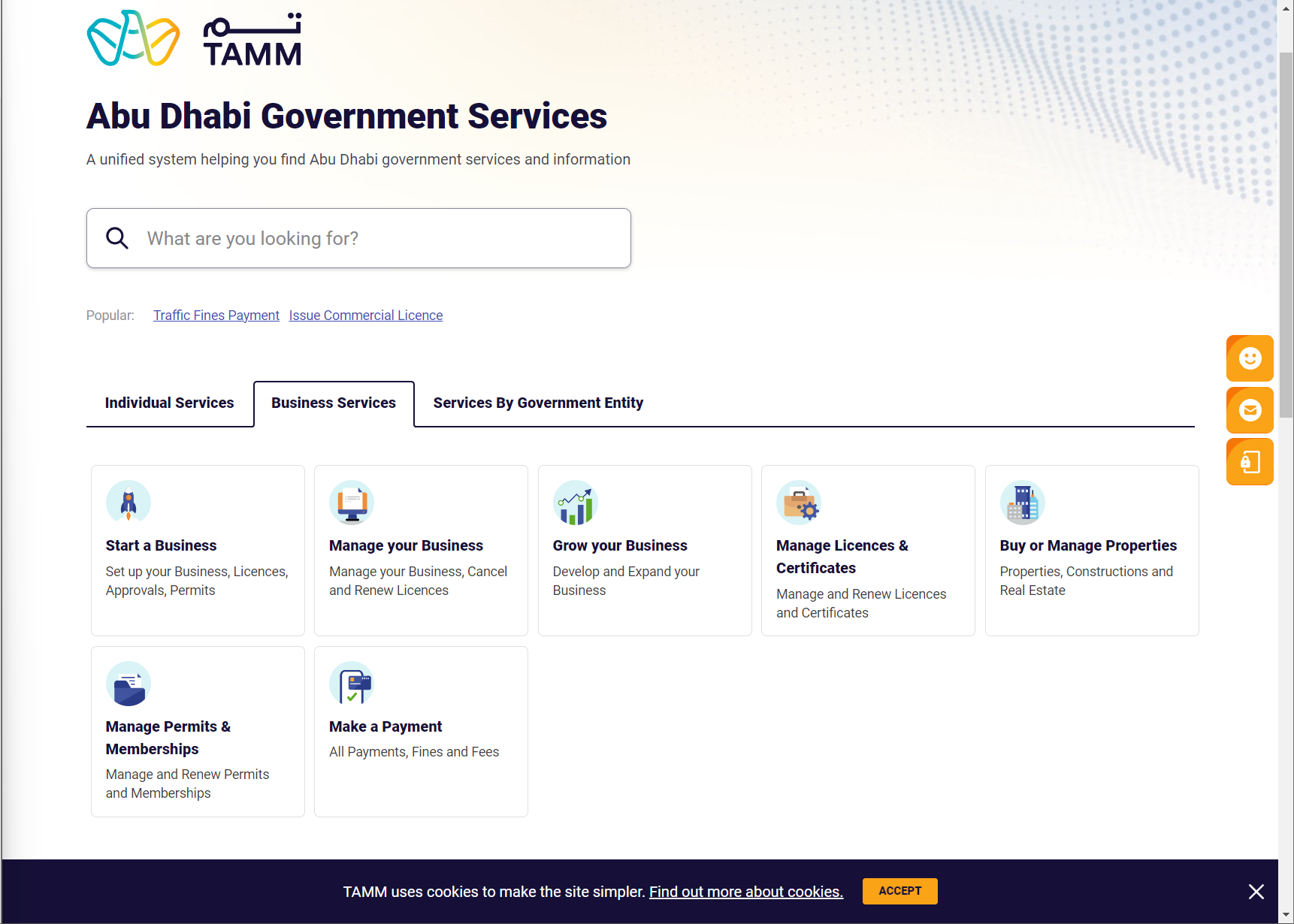
Abu Dhabi has developed a [catalogue ](https://www.tamm.abudhabi/)that clusters services based on user/business life events. The following image shows the front end of the One-Stop-Shop for services offered by the Abu Dhabi government:

<figure><img src="https://content.gitbook.com/content/AjfvR3V09S9HmlHskZ6N/blobs/LMIl60j4X1FVN1lNzoHK/Screenshot%202023-03-31%20160338.png" alt=""><figcaption><p>User/business life events, from Abu Dhabi, Finalist of GovStack WSIS Special Prize 2023</p></figcaption></figure>

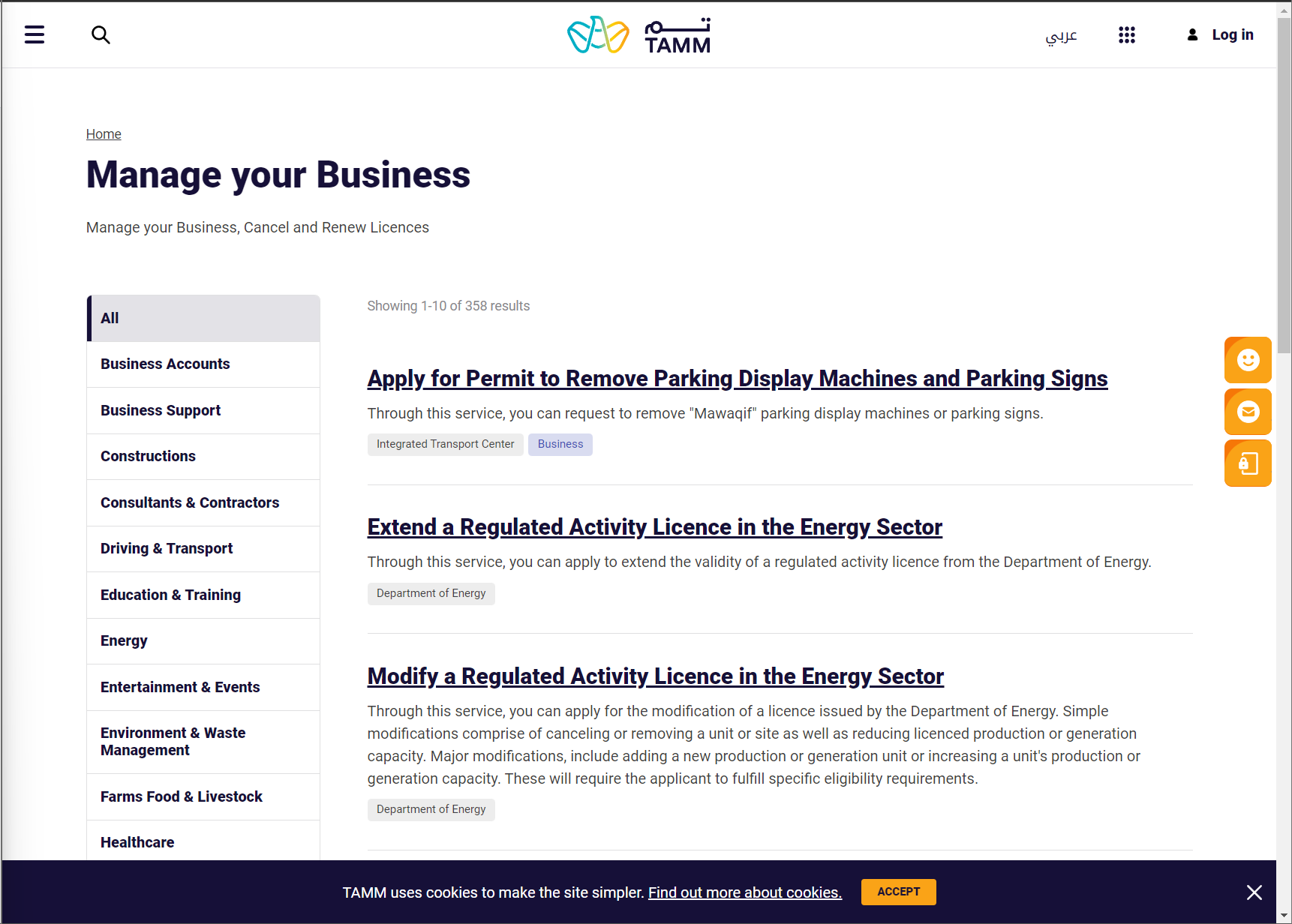
The following images show the services within each cluster within the user/business life events:

<figure><img src="https://content.gitbook.com/content/AjfvR3V09S9HmlHskZ6N/blobs/TRGYminC1DTHdTF23dhH/Screenshot%202023-03-31%20160404.png" alt=""><figcaption><p>Catalogue of services related to 'Manage your Business', from Abu Dhabi, Finalist of GovStack WSIS Special Prize 2023</p></figcaption></figure>

</details>

<details>

<summary><strong>Argentine chatbot "Tina"</strong> </summary>

Another innovative example is the chatbot developed by the Argentine government. Tina is a trans-actional chatbot that retrieves information from Argentina's digital service catalogue and presents it over chat to its users. This demonstrates the possibility to share the machine-readable content of services with users via multiple channels.

<https://youtu.be/dKvmax9vjV4>

{% embed url="<https://youtu.be/dKvmax9vjV4>" %}

</details>

<details>

<summary><strong>Unique digital platform of the Peruvian State</strong></summary>

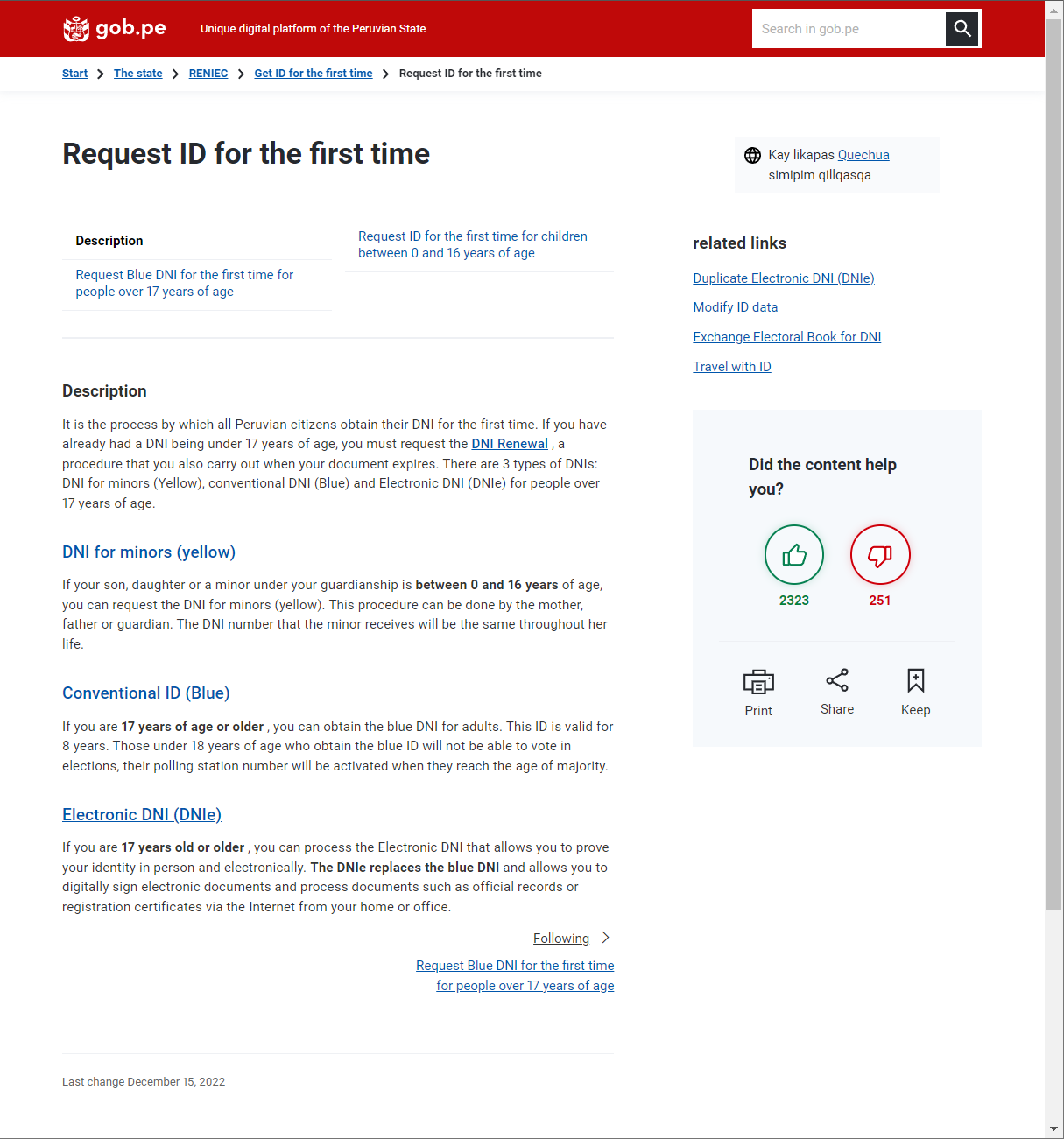
The landing page of [gob.pe](https://www.gob.pe/) that presents the most demanded services:

{% hint style="info" %}
![](https://specs.govstack.global/~gitbook/image?url=https%3A%2F%2Fcontent.gitbook.com%2Fcontent%2FDLeKag4x9xUV26hiPlNo%2Fblobs%2FPDeQ40mjX4z9cDgNDmhK%2FGob.pe.png\&width=768\&dpr=3\&quality=100\&sign=68884fde\&sv=2)
{% endhint %}

Each service has its own dedicated service information sheet that presents requirements, citizen feedback on the quality of information on the service sheet, and the date on which the service sheet was last updated.

<figure><img src="https://content.gitbook.com/content/AjfvR3V09S9HmlHskZ6N/blobs/2yxUPM2AxKPK2jvfZ4Cj/image.png" alt=""><figcaption></figcaption></figure>

</details>

## Activities

* Define the structure of the catalogue of services. [RFI-II](https://view.officeapps.live.com/op/view.aspx?src=https%3A%2F%2Fcontent.gitbook.com%2Fcontent%2FDLeKag4x9xUV26hiPlNo%2Fblobs%2FyKVuezlL9ARQ9c5ZGdtI%2Fversion0.2CE%2520DSDS%2520RFI2.xlsx\&wdOrigin=BROWSELINK) provides a template to assist in cataloguing the services.

<figure><img src="https://content.gitbook.com/content/AjfvR3V09S9HmlHskZ6N/blobs/FX0FhvJvcMQYXCBwlnBX/image.png" alt=""><figcaption><p>Example of information in RFI-2</p></figcaption></figure>

* Classify services based on their digital maturity. The level of maturity of services facilitates calculating the financial and technical effort that will be required to digitalize a citizen-centric government service. An example of classification is as follows:
  * **Level 1 - Informative:** Information on the service is made available online yet the actual transaction happens in person.&#x20;
  * **Level 2 - Downloadable forms**: The users can download and complete the forms while having to submit the same forms in-person or upload the documents.
  * **Level 3 - Submission of webform:** Users can validate data showcased on the web form, upload the required documents, fill out forms, and submit them remotely.
  * **Level 4:** 100% online
* Understand how services are related to one another. A [User/Business Life event map](https://miro.com/app/board/uXjVOiQif00=/?share_link_id=816348815953) can enable visual mapping of services to life events, their clustering, and identification of relations and dependencies.
* Standardize information presentation to citizens/businesses:
  * **Develop a Service Information Sheet Standard (SISS):** This sheet would contain standardized fields such as service name; requirements; cost for the user; the location where the service can be obtained; concrete actions required from the user; and outcome of the service
  * **Government Entity Information Standard (GEIS):** This sheet would contain standardized fields such as the mandate of the entity, the programs it manages, and the services it provides
  * **Citizen Feedback/Participation Standard (CFPS):** A standard for the government to seek input from citizens through surveys, discussion forums, and comments on laws

## Responsibilities

Who does what:

* Head of Service Design - Lead the integration of the service catalogue
* Service Design and Delivery Focal point - Complement and update the service catalogue with services from their organisations. They follow up and coordinate the actions within their organization to digitize services according to the approved digitization roadmap
* Digital communications team: Develop UX guidelines and training focal points and perform random auditing on quality-of-service sheets to ensure they meet the service sheet standards

## Deliverables

* Service catalogue, with services mapped to citizen/business life events
* Training material on UX writing
* Service Information Sheet Standard