> For the complete documentation index, see [llms.txt](https://specs.govstack.global/llms.txt). Markdown versions of documentation pages are available by appending `.md` to page URLs; this page is available as [Markdown](https://specs.govstack.global/service-patterns/service-patterns.md).
# Service Patterns
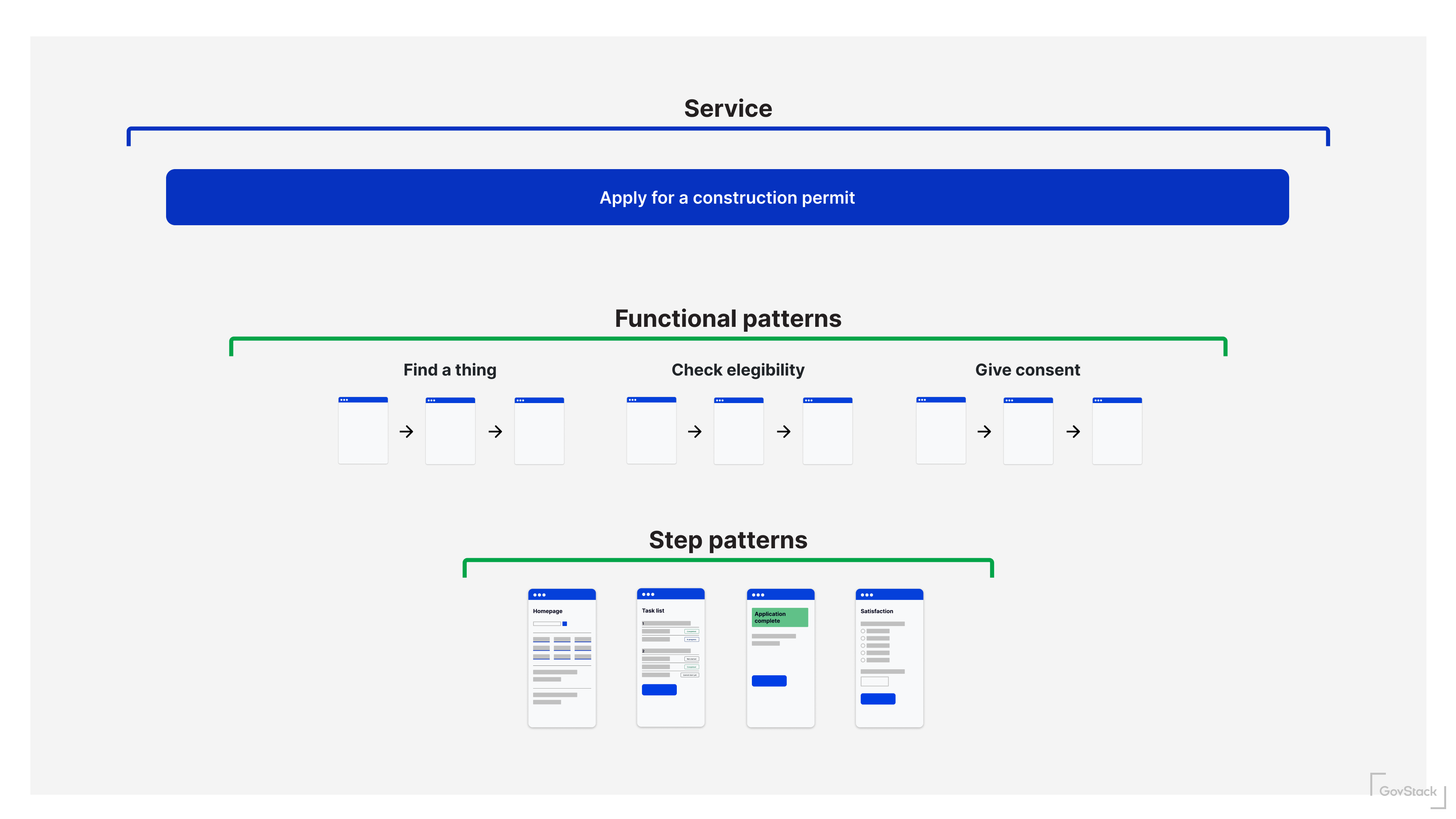
Avoid reinventing common service flows using service patterns which provide tested models of how transactional services typically work.
Service patterns operate at two levels: **functional patterns** and **step patterns**.
### Functional patterns
Functional patterns describe common end-to-end service journeys, such as:
* Apply
* Register
* Request
* Make a payment
* Report
* Book
They show the typical stages of a service and how steps connect over time.
Use functional patterns to:
* Frame the overall journey
* Identify essential stages
* Avoid structural gaps
They are starting points, not rigid templates.
[2. Functional patterns](/service-patterns/2.-functional-patterns.md)
### Step patterns
Step patterns are steps that are reused across many journeys.
Examples include:
* Collect information
* Verify identity
* Upload documents
* Match records
* Calculate fees
* Send notification
Each step pattern includes guidance on purpose, content, user considerations, and technical implications.
Use step patterns to help you:
* Design consistent interactions
* Align with building blocks
* Reduce common usability errors
[3. Step patterns](/service-patterns/3.-step-patterns.md)
### How to use service patterns
Service patterns support the [GovStack Implementation Playbook](/implementation-playbook/1.0.0-rc/implementation/design-service/2-designing-the-future-service-to-be.md).
You can use them to:
* Compare your **as-is** service against common structures
* Assemble and adapt a **to-be** journey
* Prototype faster with fewer unknowns
* Align service design with architecture
Patterns do not replace research or testing. They accelerate it.
Start with a functional pattern, select the relevant step patterns, adapt them to your context, and validate through user testing.
---
# Agent Instructions
This documentation is published with GitBook. GitBook is the documentation platform designed so that both humans and AI agents can read, navigate, and reason over technical content effectively. Learn more at gitbook.com.
## Querying This Documentation
If you need additional information that is not directly available in this page, you can query the documentation by asking a question.
Perform an HTTP GET request on the following URL with the `ask` and `goal` query parameters:
```
GET https://specs.govstack.global/service-patterns/service-patterns.md?ask=&goal=
```
`ask` is the immediate question: it should be specific, self-contained, and written in natural language.
`goal` is what the user is ultimately trying to achieve, the reason they need the answer. Sharing it helps GitBook give you a better, more relevant answer. A goal is most helpful when it describes the outcome the user wants rather than restating the question. For example, with `ask=how do I create an API token`, a goal like `automate deployments from our CI pipeline` lets GitBook tailor the answer to that use case.
The response will contain a direct answer to the question and relevant excerpts and sources from the documentation.
Use this mechanism when the answer is not explicitly present in the current page, you need clarification or additional context, or you want to retrieve related documentation sections.