

Journey
Capacity Building Journey
Capacity-building process involves establishing and enhancing skills, instincts, abilities, processes, and resources that organizations and communities require to survive, adapt, and thrive in a rapidly changing world. Organizations share information, skills, and best practices through capacity development. GovStack's methodology is highly iterative and co-creation based (ITU 2022).
The main activities within GovStack GovStack Capacity Building approach is described as follows:
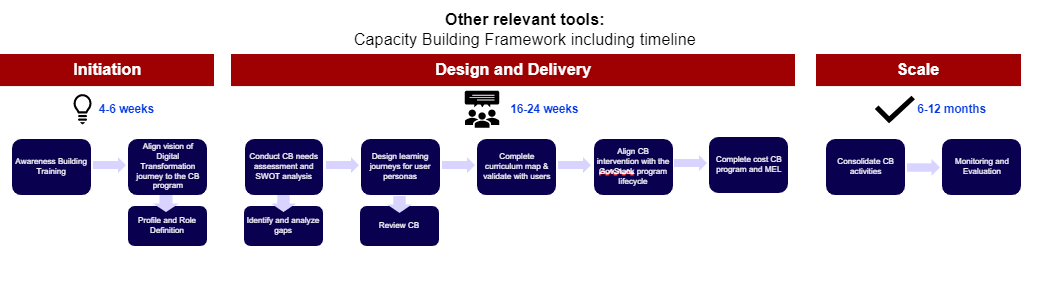
12 steps of the Capacity Framework Journey
Define profiles, roles, and qualifications to understand the existing roles of the country. Prioritize profiles based on its criticality.
Conduct capacity building needs assessment and SWOT analysis
Identify gaps and try to understand what type of skills are needed, using RFI 4 as a guide.
Review capacity-building inventory and identify gaps in capacity-building assets.
Complete curriculum map and validate with users in order to understand what type of skills are needed.
Align capacity-building intervention.
Design learning journeys per one user persona.
The design team and organizational interventions.
Complete and cost capacity building program and MEL.
Consolidate capacity building activities.
Pilot, test, and refine training per user persona.
Implement, assess, and improve interventions
The process of these activities and main tools used can be found in the Capacity Building Framework Journey below.
Additionally, GovStack has created a supportive environment for capacity building by creating various training materials collected in the GovStack e-learning hub. It consists of different modules which are aimed towards supporting capacity building phases during the whole GovStack implementation Journey.
Development and Customization of Capacity Building
GovStack focuses a lot on process and people within the implementation journey. Capacity building is the process in which individuals, organizations and societies, develop, strengthen and maintain the skills to implement GovStack’s Building Blocks. Capacity development is not a single intervention but an iterative process of design-application-learning-adjustment.
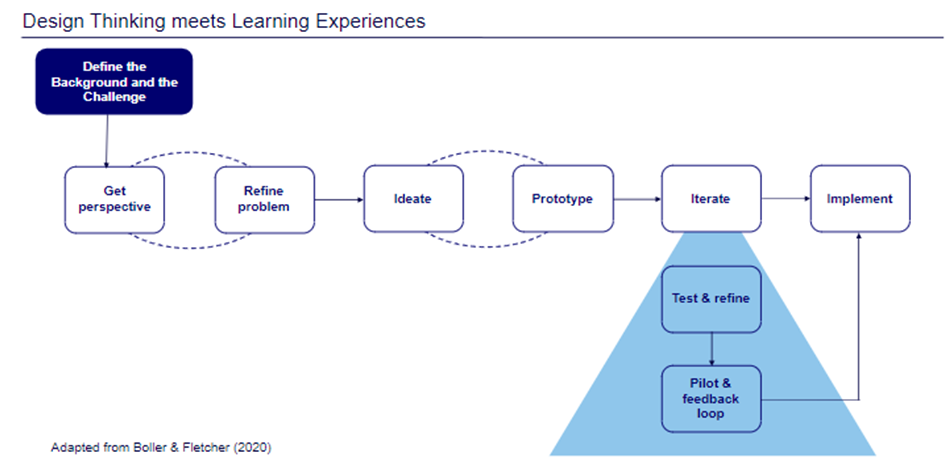
Development and Customization Model
The model employs design-thinking and human-centric design methodologies for learning and performance. Thus, instead of focusing on learning a topic or combination of topics, it focuses on solving problems and achieving stated organizational goals.
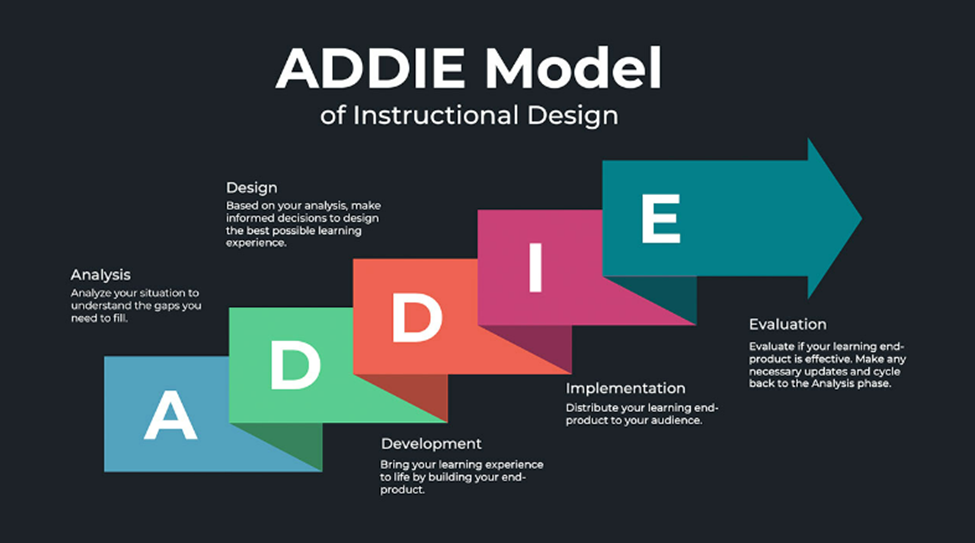
It involves 3 phases as described below:
Phase 1 - Pre-planning
What is the concept you are exploring? Develop a capacity building framework that complements launching digital government services (GovStack/BB) as well helps to build digital competency/readiness among Government agencies.
What is the challenge or opportunity this concept addresses?
Which groups need to be involved in addressing the concept? (Stakeholder map)
a. Who // What we know and what we need to know // Concerns and expectations // Desired impact // Motivation
Which groups are NOT impacted by it and how might they react? (Stakeholder map)
Capacity building assessment
Phase II - Gain Perspective and Refine the Problem
Gap analysis and adaptation plan
Organizational context:
Goals, strategies and structure
History (recent success or failure)
Internal Environment
External Environment
Multi-level approach
Individual
Communities of practice (technical, intra-organization, etc.)
Stakeholder interaction
Enabling conditions
Data Sources
Primary source (government documentation)
UN e-Government Knowledge base
World Bank Country Diagnostics
UNDP
Policy and strategy documents
Data Gathering (Capacity building)
UNDP - Digital government capability assessment
World Bank Digital Government Readiness document and tutorial
Current assets
Refine the problem (multi-stakeholder engagement)
National Digital Strategy and National M&E Plan
National Strategy and National M&E Plan Is there a National Strategy related to the relevant use cases addressed by the Program or project(s)? Is there a National M&E Plan linked to the National Strategy?
Goals and Objectives of the Program/Project(s)
Are the goals and objectives of the Program or project(s) in line with the National Strategy and are they time bound and measurable?
M&E Indicators in the Program/Project(s)
Do indicators have clear definitions, data sources with baselines and targets? Were indicators selected in collaboration with national/international M&E partners? Is indicator data linked with the National M&E system?
Communication Plan and Transparency
Will data from the Program or project(s) be disseminated properly and will sensitive data remain confidential?
Capacity Building Budget
Has the Program or project allocated sufficient financial resources for M&E?
Phase III – Capacity Building Plan
1.Why Digital Transformation
a. Challenges and Opportunities
b. Case studies
c. Country approach (successful approach and lessons learned)
d. Capacity building in a Digital government
2. GovStack Life-cycle and competencies framework
a. Governance and Strategy
b. Digital Service Design & Delivery Standard
c. Capacity Building
Learner personas
Leader: strategy blueprint GovStack implementation and Individual level (user profile "Top management")
Chief Information Officer (user profile "Top management/IT specialist")
Chief Technology Officer (user profile "Top management/IT specialist")
Project Manager (user profile "Middle management")
Domain Experts and architects (user profile "IT specialist")
Service designers (user profile "Service design")
Change Management and Capacity Development (user profile "Trainers")
Finance (user profile "Middle management")
Citizen Engagement (user profile "Trainer")
Policy Makers (user profile "Policy maker")
d. Curriculum adaptation
e. Action Plan. Find below an example
Detailed description of the Strengthening Measure
Responsibility
Timeline
Total Funding
Funding source
Technical Assistance
Priority setting and action planning (multi-stakeholder exercise)
Monitoring, Evaluation, and Learning
Capacity building template:
Background
Learner persona
Objectives
Thematic focus
Methodology
Instructional Design
Evaluation: Pre-training survey, after
Agenda
Implementation plan
What, how and who
Timeline and target dates
Accountability
Assumptions
Budget
Monitoring, Evaluation and Learning
Risks
5. The training plan as an important plan of the capacity building:
The platforms and tools which can be used as a training platform
Different level of the trainings (top/middle management, end users, service designers, technician who should know the BB)
Implementation methodology and possible timeline (what kind of trainings are needed, who is responsible)
Effective strategies for imparting training
For many years, research and practice has recognized differences between how children and adults learn. Thus, this section highlights high-level adult learning theory along with recommendations to enhance practice for the effective implementation of GovStack's BB.
Adults need to know the reason for learning something
In practical terms, it is important that instructors clearly describe the learning objectives and provide spaces to understand participant’s motivations when preparing learning materials (e.g., collecting participants’ information during the planning stage, mapping participants’ expectations at the beginning of capacity building sessions and making connections between the content presented throughout the sessions
Adult life experiences are a rich resource for learning (or barrier)...
Over the years, adults accumulate knowledge and experiences that can be leveraged as learning resources. In fact, cognitive science has shown that adults tend to resort to past knowledge as a primary learning tool. These experiences can be harnessed through pairing exercises, groups discussions, and problem-solving exercises.
As people mature there is a change in time perspective...
Adults tend to prioritize acquiring knowledge that ca be applied immediately. In that sense, knowledge that can directly applied to life or work-related situations can be more attractive to adult learners than purely academic or theoretical approaches
Learning styles are influenced by personality type, educational background, career choices, and current job role and associated tasks. Designing capacity building programs that engage different learning styles techniques and adapt to different contexts can be an effective way to ensure that learning objectives are met.
Last updated
Was this helpful?