> For the complete documentation index, see [llms.txt](https://specs.govstack.global/llms.txt). Markdown versions of documentation pages are available by appending `.md` to page URLs; this page is available as [Markdown](https://specs.govstack.global/payments/9-internal-workflows/9.5-business-to-government-b2g.md).
# 9.5 Business to Government (B2G)
### 9.5.1 Example workflow of a business paying for government services and refuse collection
In this example the local Government provides a refuse collection service to local businesses this consists of both regular collections and the ability to request additional collections. These services are chargeable by the local Government to the local businesses.
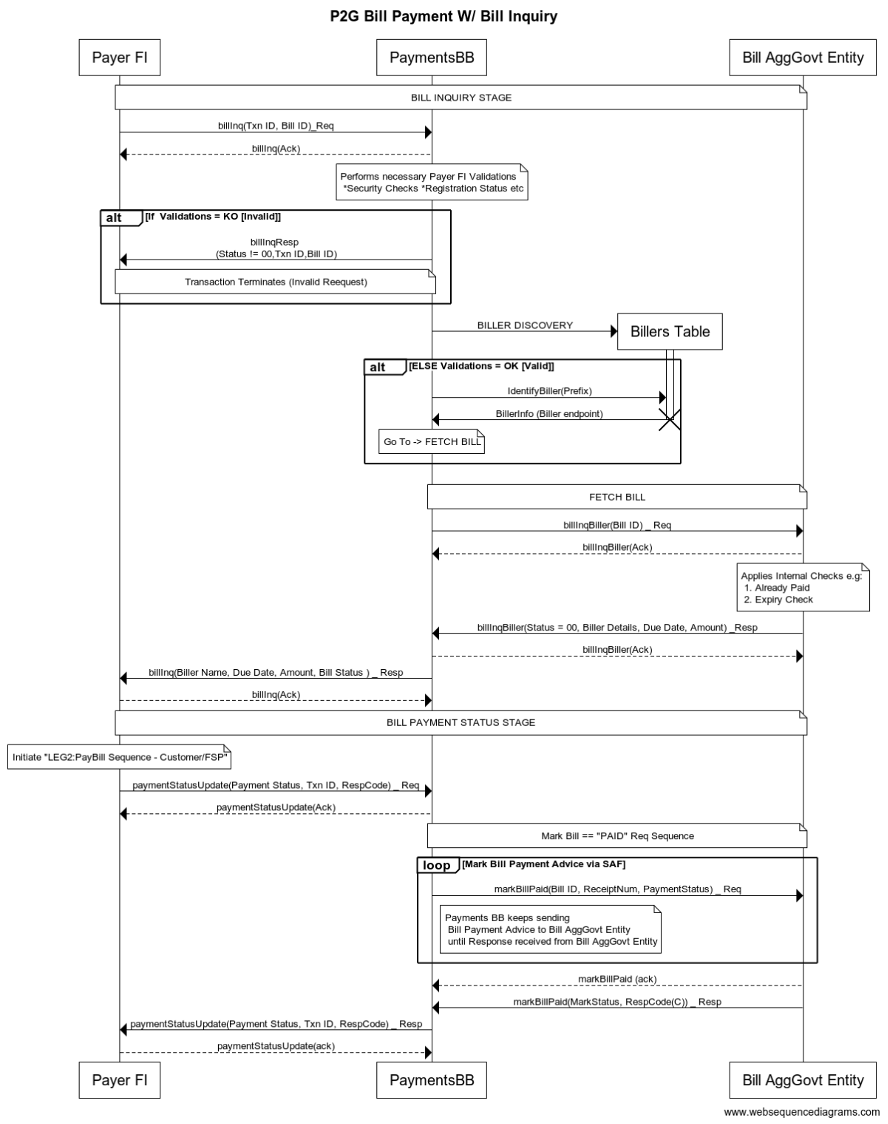
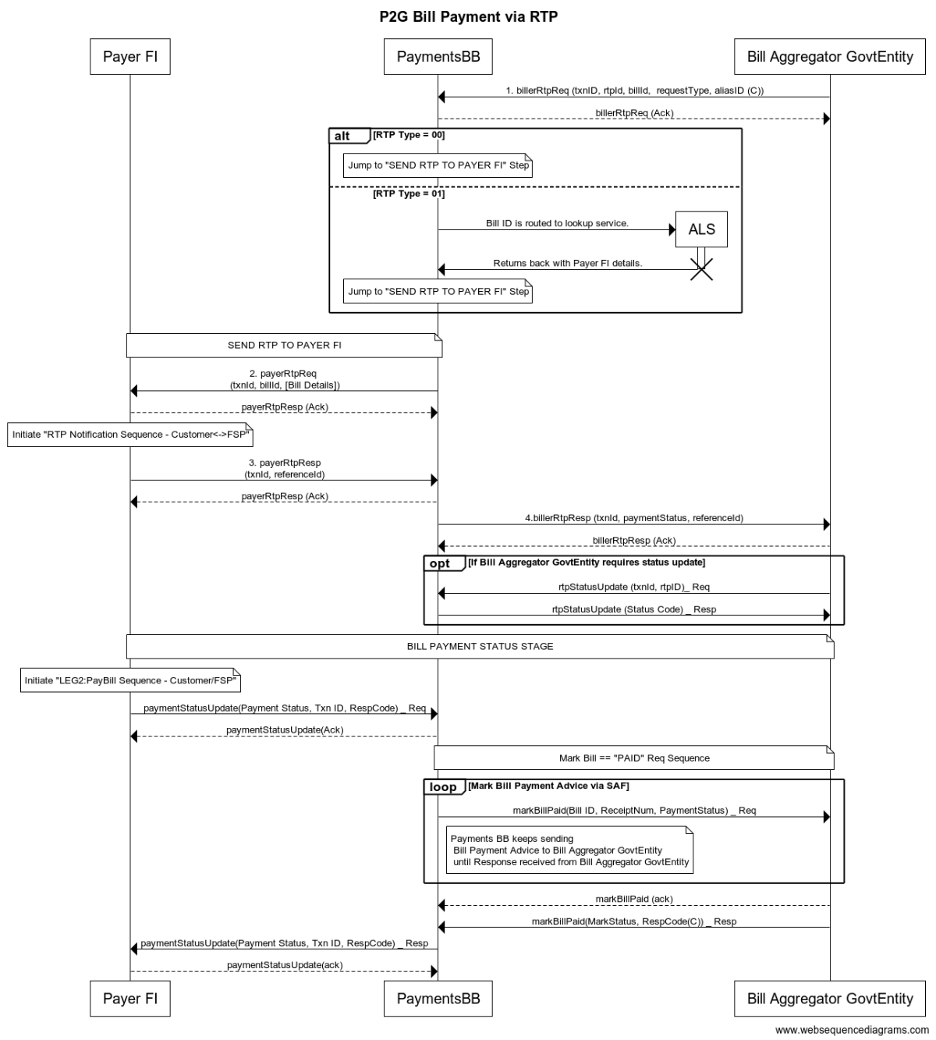
If we look at the existing Person to Government (P2G) payment use-case we see that within this the flows are agnostic of if the Payer is an individual or a business and the ID of the Payer is not within the flows or APIs resolving the concerns that arise in G2B payments that need changes to cater for business scenarios.
[Final Versions of Key Documents | P2G v16Oct23](https://govstack-global.atlassian.net/wiki/spaces/GH/pages/490962995/Final+Versions+of+Key+Documents#P2G-v16Oct23)
Hence we can conclude the following flows would be used:
For the regular bills these would follow the Bill Generation and Bill Inquiry workflows with Bills being sent from the Billing Entity to the Payer who would pay with the reference supplied enabling the Payment BB to reconcile the payments to the Billing table.
For the one off charges this would follow a one-time Request to Pay workflow from the Billing entity to the Payer.
The use of a billing aggregator could also be supported for G2B payments without any adjustments foreseen.
\
---
# Agent Instructions
This documentation is published with GitBook. GitBook is the documentation platform designed so that both humans and AI agents can read, navigate, and reason over technical content effectively. Learn more at gitbook.com.
## Querying This Documentation
If you need additional information that is not directly available in this page, you can query the documentation by asking a question.
Perform an HTTP GET request on the following URL with the `ask` and `goal` query parameters:
```
GET https://specs.govstack.global/payments/9-internal-workflows/9.5-business-to-government-b2g.md?ask=&goal=
```
`ask` is the immediate question: it should be specific, self-contained, and written in natural language.
`goal` is what the user is ultimately trying to achieve, the reason they need the answer. Sharing it helps GitBook give you a better, more relevant answer. A goal is most helpful when it describes the outcome the user wants rather than restating the question. For example, with `ask=how do I create an API token`, a goal like `automate deployments from our CI pipeline` lets GitBook tailor the answer to that use case.
The response will contain a direct answer to the question and relevant excerpts and sources from the documentation.
Use this mechanism when the answer is not explicitly present in the current page, you need clarification or additional context, or you want to retrieve related documentation sections.