> For the complete documentation index, see [llms.txt](https://specs.govstack.global/llms.txt). Markdown versions of documentation pages are available by appending `.md` to page URLs; this page is available as [Markdown](https://specs.govstack.global/overview/23q4/govstack-ui-ux-guidelines/4-design-patterns/6-page-templates/7.3-satisfaction.md).
# 4.3.3 Satisfaction
## **How it Works**
### **Satisfaction Survey**
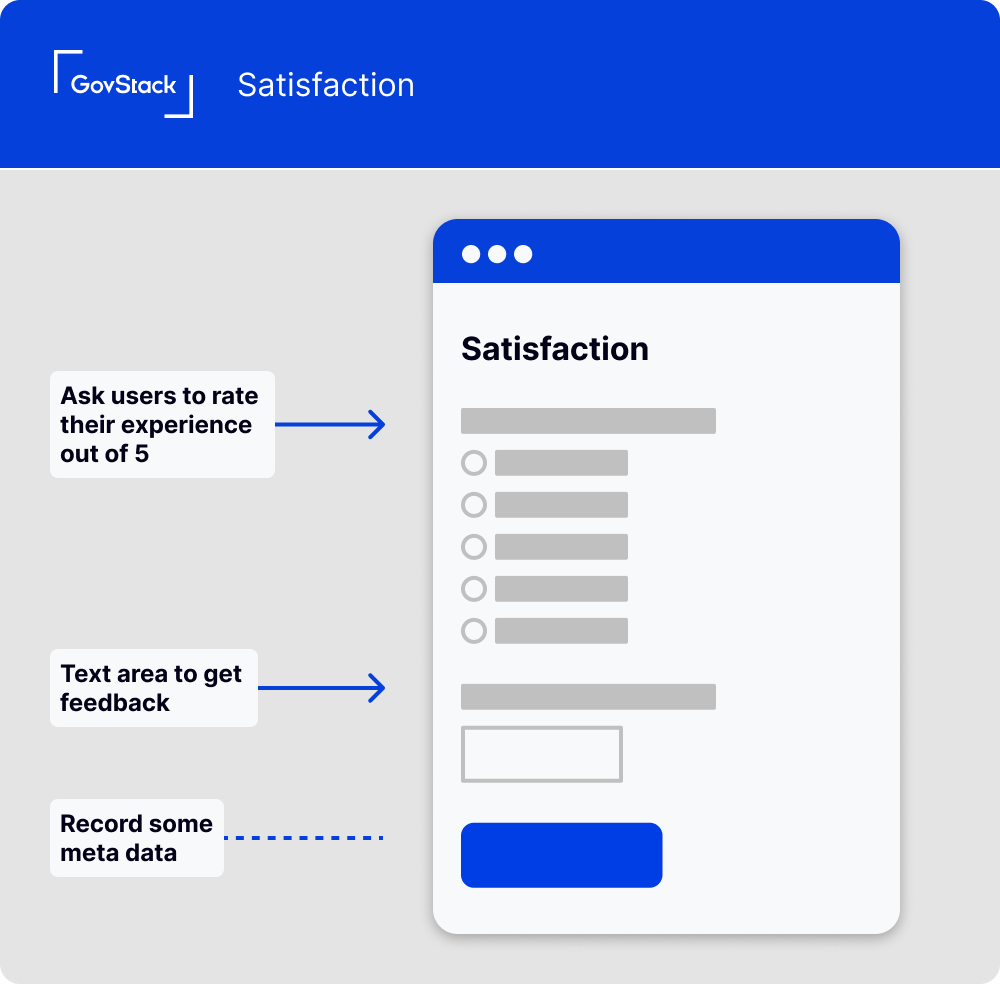
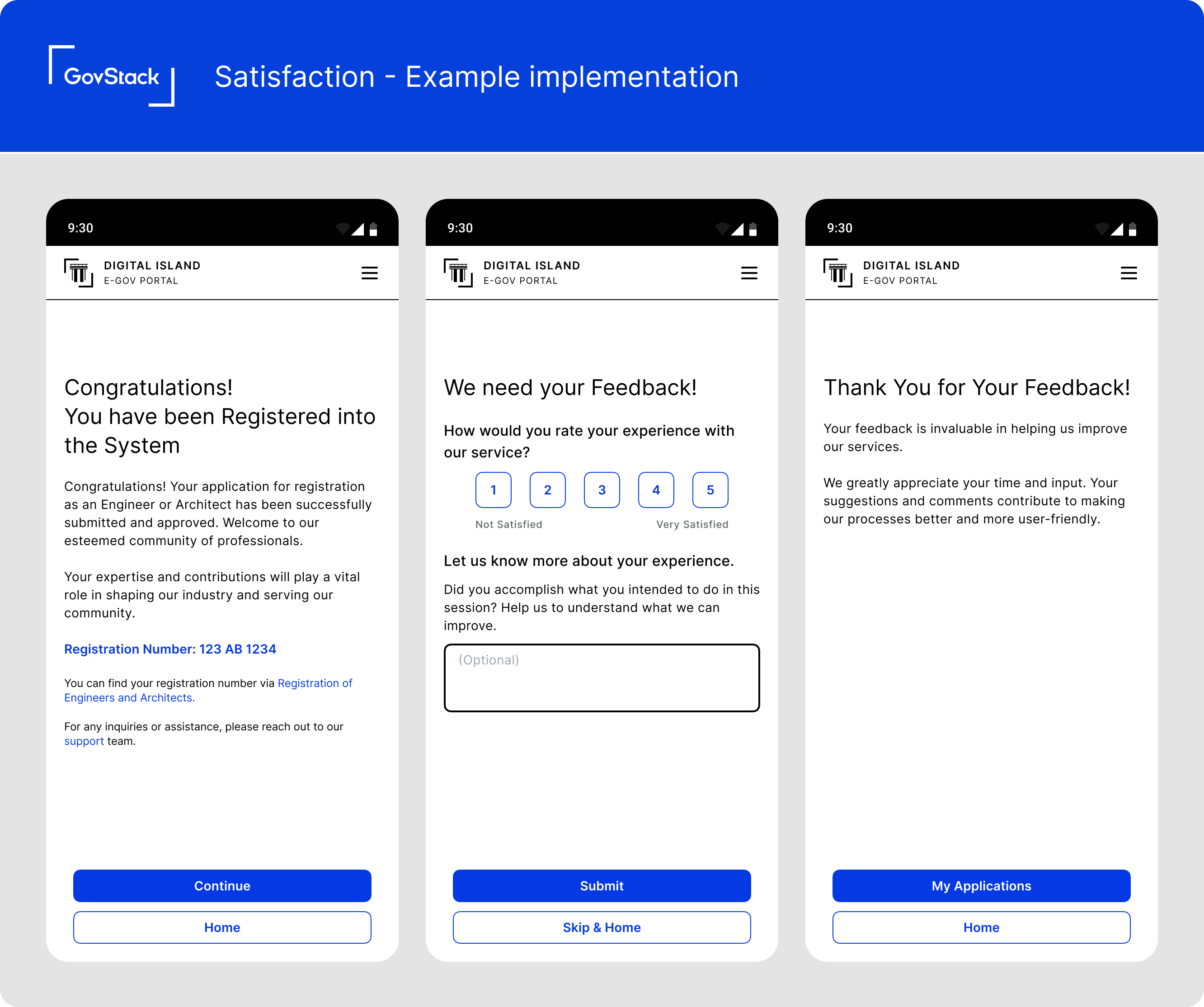
At the end point of the user journey, prompt users to rate their experience. This should be a simple rating scale (1-5) or a binary satisfied/dissatisfied question.
### **Open-ended Feedback**
Following the rating, provide a text field for users to share more details about their experience. Prompt users with an open-ended question like, "How could we improve your experience?"
### **Submit Button**
Include a clear 'submit' button to finalise their feedback.
### **Success Message**
Display a success message after submission, thanking them for their feedback.
### **Data you might Collect**
* **User Satisfaction Score:** The user's response to the satisfaction rating question.
* **Feedback Text:** The user's response to the open-ended feedback question.
* **Page URL:** The URL of the page from which the feedback was submitted.
* **Session ID:** Identifies the particular user session, for associating feedback with specific user journeys.
### **Potential Questions for User Survey**
Consider adding questions to your satisfaction survey to gain deeper insights:
* **Did you accomplish what you intended to do in this session?** Helps understand if the user journey was effective and efficient
## **When to use this pattern**
Use this pattern at the end of a user journey to collect valuable feedback about user experiences. Be aware that user satisfaction is biased to users that reach an end-point of a service.
##
---
# Agent Instructions
This documentation is published with GitBook. GitBook is the documentation platform designed so that both humans and AI agents can read, navigate, and reason over technical content effectively. Learn more at gitbook.com.
## Querying This Documentation
If you need additional information that is not directly available in this page, you can query the documentation by asking a question.
Perform an HTTP GET request on the following URL with the `ask` and `goal` query parameters:
```
GET https://specs.govstack.global/overview/23q4/govstack-ui-ux-guidelines/4-design-patterns/6-page-templates/7.3-satisfaction.md?ask=&goal=
```
`ask` is the immediate question: it should be specific, self-contained, and written in natural language.
`goal` is what the user is ultimately trying to achieve, the reason they need the answer. Sharing it helps GitBook give you a better, more relevant answer. A goal is most helpful when it describes the outcome the user wants rather than restating the question. For example, with `ask=how do I create an API token`, a goal like `automate deployments from our CI pipeline` lets GitBook tailor the answer to that use case.
The response will contain a direct answer to the question and relevant excerpts and sources from the documentation.
Use this mechanism when the answer is not explicitly present in the current page, you need clarification or additional context, or you want to retrieve related documentation sections.