

2. Collect Market Insights
This section outlines the key activites of collecting insights, such as early market engagement as a feedback mechanism, the use of GovMarket, and the distinction between software and service provider research. It also provides links to relevant procurement resources. Together, these elements help institutions build a full picture of the market while preparing for the next stage of the procurement process.
Use of Market Research for Feedback
Public institutions can use a structured market research approach to get an overview of the existing capabilities, standards and solutions in the marketplace. This may be done before initiating a formal procurement process. A structured market research approach enables governments to validate assumptions, refine technical requirements, and design tenders that are realistic.
International procurement frameworks consistently position market research as a core mechanism for informed decision‑making.
The EU ICT Procurement Guidelines instruct institutions to apply market research proactively when defining technical specifications. This helps identify existing ICT solutions, assess their reusability, understand available open standards, and avoid vendor lock‑in.
The World Bank Procurement Framework similarly calls for early market engagement research to ensure procurement practices align with actual market capabilities and support value‑for‑money outcomes.
The graphic below illustrates the early market engagement cycle.
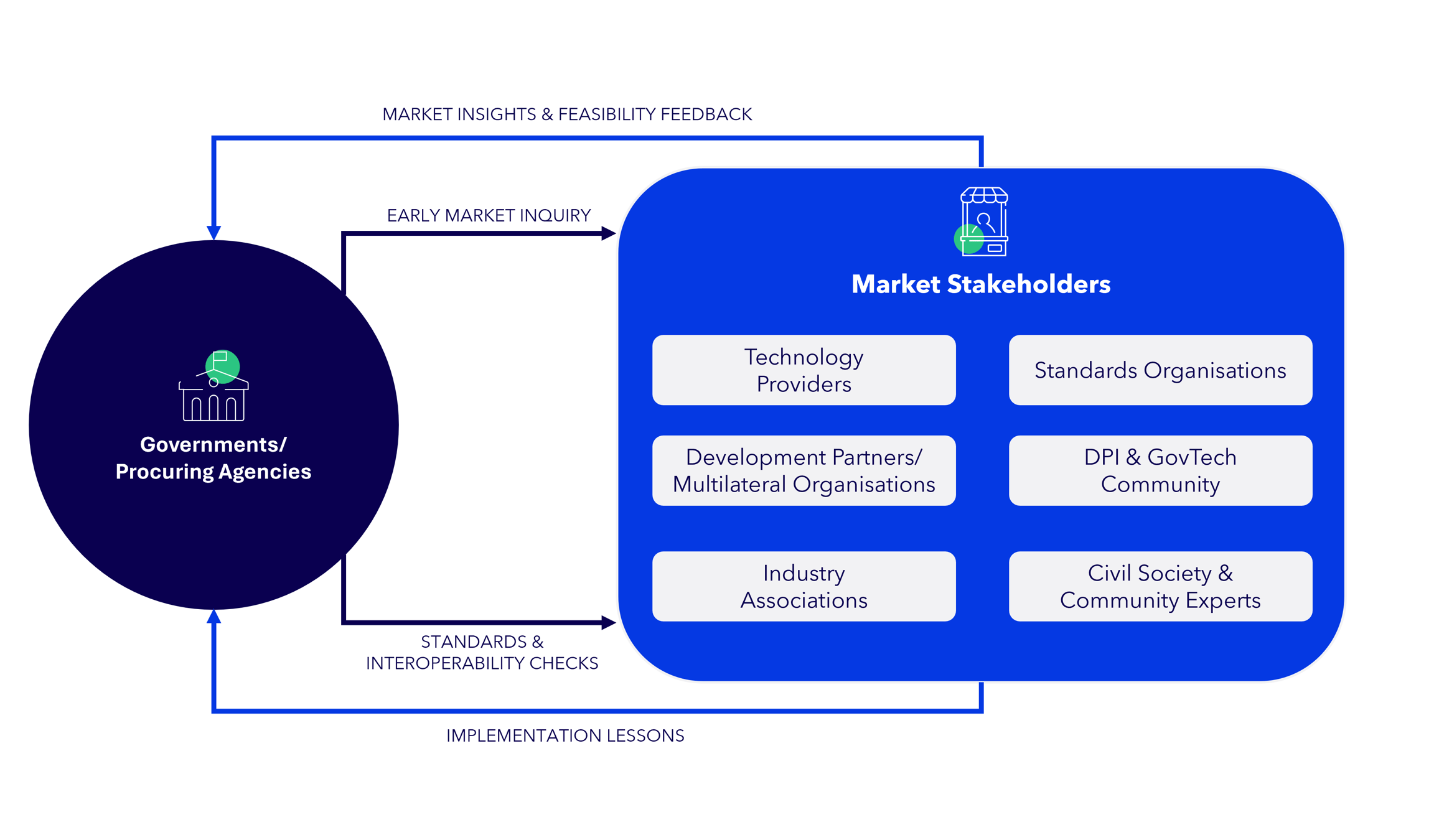
Early engagement with the market encourages governments to understand which GovStack‑aligned solutions or components already exist and to identify which technical standards, APIs, and architectural patterns are widely supported in the market. Furthermore, it helps in analyzing realistic cost structures, licensing models, and implementation timelines. Governments can also benefit from this practice by assessing where innovation is emerging and how it may influence requirements and by avoiding tailored solutions that reduce competition or restrict interoperability.
Typical market research activities include:
Issuing Requests for Information (RFIs) or supplier questionnaires to gather non‑binding input
Hosting transparent supplier consultations or briefings, ensuring equal access for all potential bidders
Reviewing existing reusable government ICT solutions, as recommended in EU guidance
Testing preliminary concepts through demos, sandbox sessions, or pilots
Consulting other governments or agencies that have implemented similar digital public infrastructure
Mapping market‑supported standards, protocols, and interoperability profiles relevant to GovStack BBs
By feeding insights from these activities back into the requirement‑setting and the selection process, governments can create tender opportunities that are technically viable and competition‑friendly.
By channeling feedback from suppliers (RFIs, consultations), market scans (capabilities, cost and licensing patterns), standards reviews (APIs, interoperability profiles), and peer governments (implementation lessons) into requirements and evaluation criteria, teams shape tenders that are technically feasible and competition‑friendly.
Capture what is broadly supported, flag constraints early, and document any justified deviations from GovStack‑aligned standards for governance review. The result is provider selection that builds resilient, interoperable, future‑ready digital public services consistent with the GovStack approach.
To further support this research phase, governments can use GovMarket to explore GovStack‑aligned software solutions and service providers. The platform acts as a matchmaking tool, helping institutions understand which providers operate within the GovStack framework. Moreover, it offers a structured overview of the existing digital solution landscape before procurement begins.
GovMarket
To enable this matchmaking process, GovStack offers a suite of services including the GovMarket. GovMarket is an online database that helps governments and service providers find each other based on a common reference point: GovSpecs. See image below to understand how GovMarket facilitates this process.
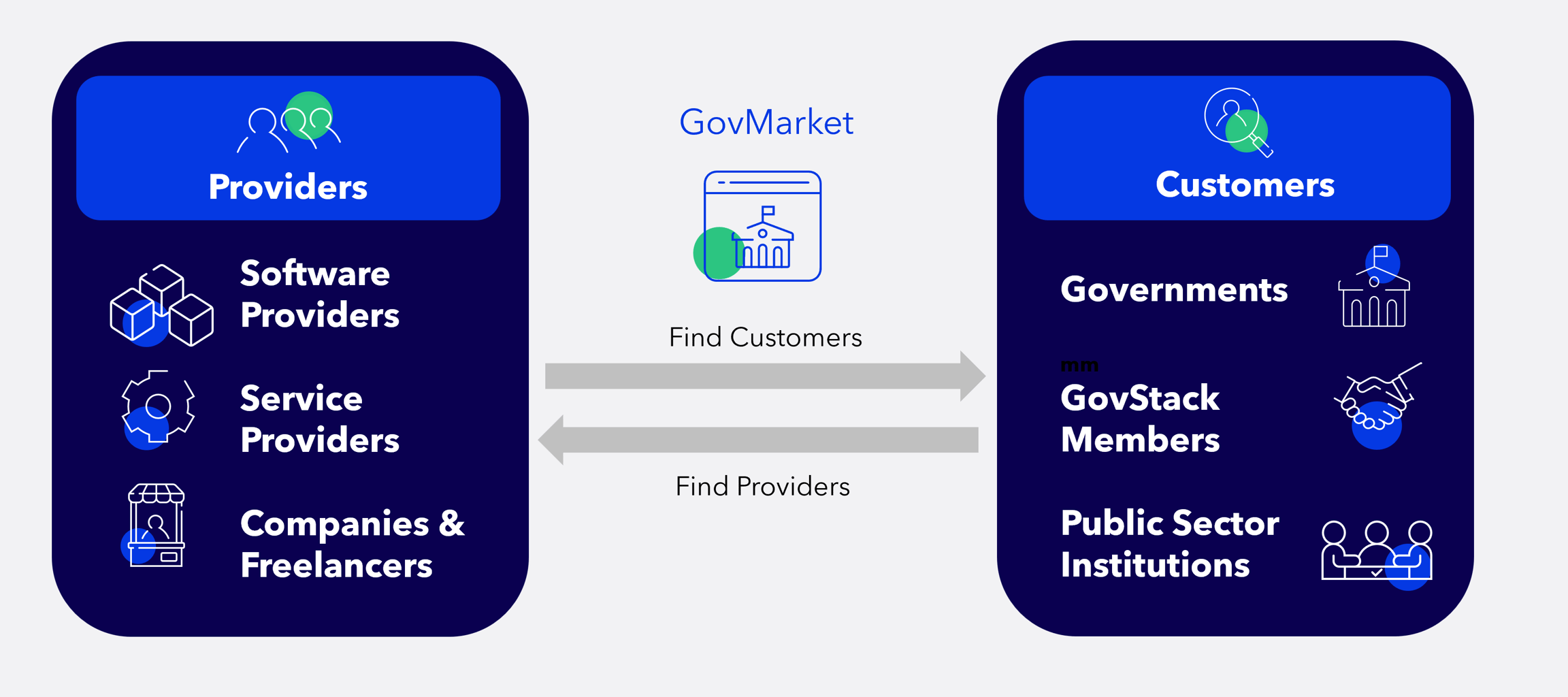
Function of GovMarket - for Governments:
During the phase of researching, planning or procuring software or services, GovMarket enables the countries to:
Identify software that is compliant to one or more Building Block Specifications.
Identify service providers offering advisory, implementation or other services aligned to the GovStack approach.
Function of GovMarket - for Providers:
For providers, GovMarket offers a unified way to showcase software and services to potential customers, and enables them to:
Find RFPs, contracts or other funding opportunities published by governments using the GovStack approach.
Find Request for Proposals from Governments using the GovStack approach.
Hence, by using GovMarket, governments can find both software providers and services that offer, for example, advisory, assist with implementation, or maintenance. The BB software providers are assessed against Govstack Building Block Specifications and fulfilling the non- functional requirements such as how solutions should behave and integrate within a modular architecture. The BB Software compliance is measured across categories such as deployment, functional requirements, and API service specifications. You can find detailed information on how compliance is measured here.
If a country identifies additional potential software providers, they can be introduced to the GovStack pool by participating in the compliance process via the GovStack Testing App. All information regarding compliance criteria and 'how-to' submit assessments can be found here.
In addition to software, the platform provides a list of companies and freelancers with proven GovStack experience. These service providers bring expertise in key areas of knowledge and enable countries to choose from an expert pool of service providers. Service providers who would wish to be a part of the pool, can check for information regarding eligibility and application process here.
After gaining an initial overview of the available solutions and provides on the GovMarket platform, governments must determine how to evaluate them appropriately. This involves distinguishing software research from service provider research. This differentiation helps institutions evaluate the product and the provider on their own merits.
Both the differentiation analysis and the procurement guidance resources form a part of the research and preparation phase, while also helping institutions transition into the formal procurement of software and service providers.
Once research activities are completed, the next step is to launch the formal procurement process. At this stage, governments can use the adapted SRS, market insights, and provider research to evaluate software and service providers in a structured, transparent manner.
Was this helpful?