# 5-B.5 Create Developer Guidelines
Developer Guidelines should be a document that describes the rules how one specific project should be developed. Those rules will be unique for every project, but below you will find a few recommendations that should be included.
Above all, this should be a living document - continuously updated by the developers throughout the implementation phase, based on the insights and experience gained during development. Adherence to the guidelines will be a lot better, if they include the feedback and consensus of the development team.
For a starting point, the developer guidelines should include:
* Any rules derived from governance and compliance
* adherence to [#modular-design](https://specs.govstack.global/implementation-playbook/implementation/5-b.2-create-container-diagram#modular-design "mention")and [#design-principles](https://specs.govstack.global/implementation-playbook/implementation/5-b.3-create-component-diagram#design-principles "mention")
* Recommended patterns, like
* [architecture-best-practices-and-patterns](https://specs.govstack.global/implementation-playbook/implementation/design-architecture/architecture-best-practices-and-patterns "mention")
* [GovStack Architecture Requirements](https://specs.govstack.global/architecture/6-cross-functional-requirements)
* Validation rules
* What kind of validation should be performed on the inputs.
* For example, a backend should **never trust the frontend** to provide valid inputs. Instead **validation must be performed (again) on the backend.** Otherwise there might be a threat vector for malicious actors.
* Error handling
* how errors should be handled consistently across the application
* what information is returned via the api
* what information is to be logged
* usage of error codes
* Logging Guidelines, provide guidelines on
* what information to log
* It is useful to have a unique identifier (uuid / guid) that groups log messages belonging together. An example would be a correlation id identifying an unique REST request.
* In addition, it has proven valuable to define a "logging context". The logging context contains information that will always be logged with every message.
* what log level to use when doing so
* describe a consistent way of logging error scenarios
* Design Guidelines for Components, like
* Separation of Business Code
* Code that implements business rules should be separated from code that implements technical details (REST communication, Persistence Access)
* This way the code stays more flexible and is easier to debug & maintain
* Usage of Layers
* Layered approaches are helpful to separate the business code from technical code
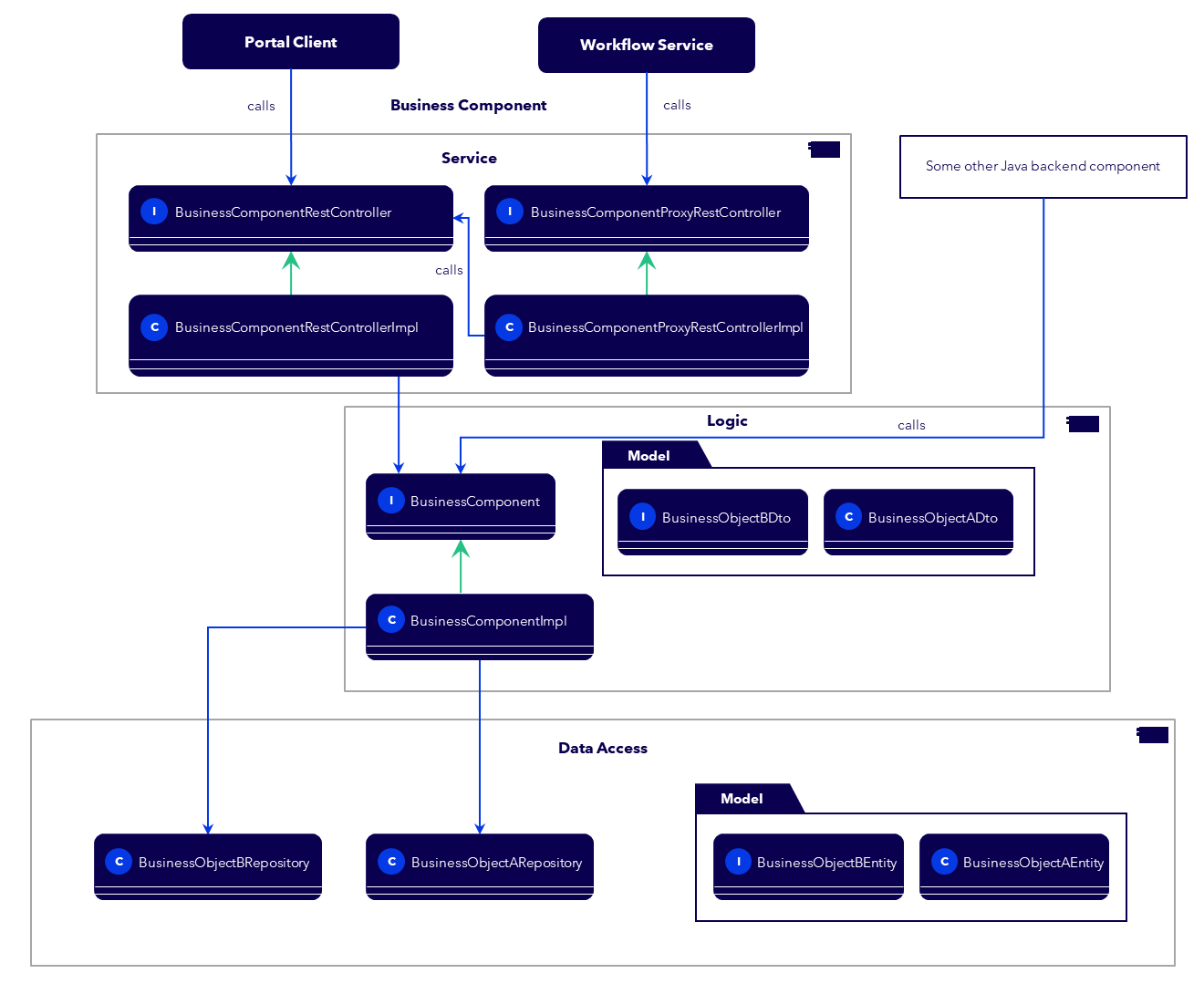
* Example:\