

Digital Strategy
Over the past years, digital transformation has become a policy priority along with traditional areas such as health policy, economic policy, labor and social protection policies. National Digital Strategies or National Digital Agendas have become guiding policy documents to establish the priorities and focus areas that respond to the country´s context and needs (OECD, 2022).
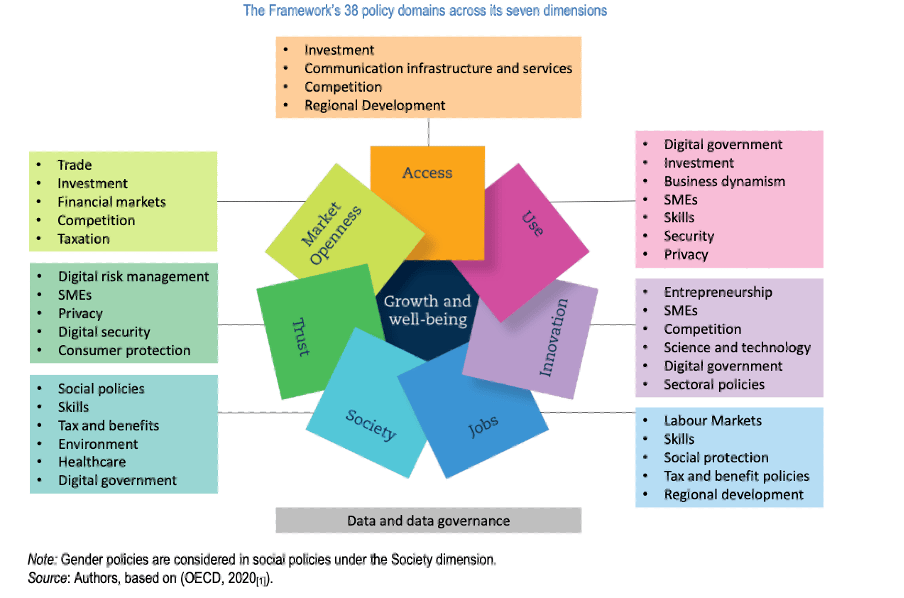
More specifically, the figure below illustrates the OECD Framework’s seven dimensions that shape national policy domains for digital transformation:
Access (orange): Ensuring investment, infrastructure, and connectivity for digital inclusion.
Use (pink): Driving adoption of digital government, skills, and security measures.
Innovation (purple): Fostering entrepreneurship, science, and technology for digital growth.
Jobs (blue): Addressing labor market changes, skills development, and social protection.
Society (light blue): Integrating social policies, healthcare, and environmental considerations.
Trust (green): Building confidence through privacy, consumer protection, and digital risk management.
Market Openness (yellow-green): Promoting trade, competition, and financial market access.
At the center, “Growth and Well-being” reflects the overarching goal of these interconnected dimensions, supported by data and data governance as a foundational layer. This mapping shows how digital transformation intersects with traditional policy areas, reinforcing its role as a cross-cutting priority.
Why Digital Strategies matter
Digital strategies matter because …
…they present governments a clear vision and roadmap for their own national digital transformation
… they align institutions and investments around shared priorities in order to avoid fragmentation.
… they enable more efficient, inclusive, as well as user-centric public services (Eggers et.al, 2021).
Typical Topics & Implementation Steps Covered in a National Digital Strategy
Most digital strategies follow a clear structure in order to ensure coherence, inclusiveness, and long-term sustainability. Some typical topics/chapters include (OECD, 2022):
4) Action Plan Development and Implementation Roadmap
Ensure process of monitoring and evaluating: A good strategy comprise rules for creating a KPI framework, depicting how progress will be specifically measured and communicated publicly. Ultimately, most strategies conclude with a concrete implementation roadmap delineating activities, milestones and sequencing.
Implementation Steps:
Create detailed plans for each action line
Define governance mechanism to coordinate implementation and responsible entities for each action line
Determine key KPI’s , milestones, dependencies, resource needs, and progress reporting
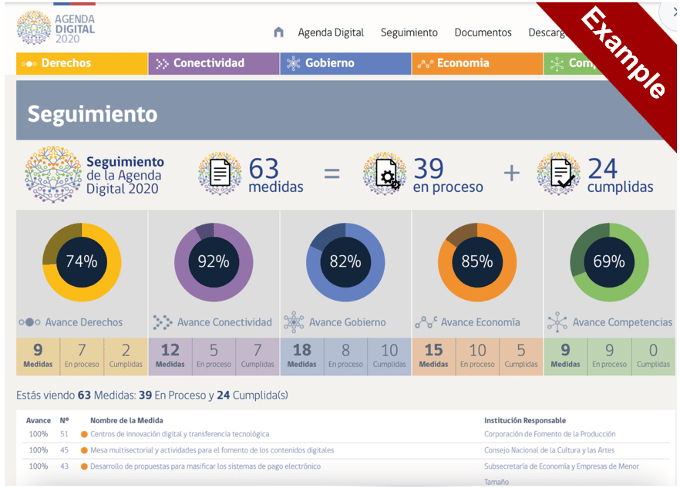
Set up a public dashboard to share progress in the implementation of the agenda and its KPI’s (c.f. figure below - Example of Chile Digital Agenda dashboard showing progress on each action line covered in the agenda)
Create a multi-phase implementation roadmap with time frames for the execution of each action line
Ensure continuous improvement along the complete implementation process
Examples of Digital Strategies
In Australia, the Digital Agenda (Digital Transformation Agency n.d.) sets 2025 as the target to have all government services available digitally.
In Estonia, the e-Estonia Policy (e-Estonia n.d.) leverages all digital capabilities of the Country to support other countries in their digital transformation journeys.
In Ireland, the Ireland Digital Framework (Department of the Taoiseach 2022) sets life events as the guiding principle for their service design and delivery.
In Mexico, the 2013 Constitutional Reform recognized the Internet as a Constitutional Right and made an obligation of the State to have a National Universal Digital Inclusion Policy (Please use Google translate to read in your preferred language).
Responsibilities
Who does what:
Head of the Digital Authority – Leads the Digital Agenda Co-Design process, coordinates the implementation and reporting mechanisms, and enables delivery of the action lines (see Implementation Steps 1,2,3,4 and 7 above)
Legal advisors – Prepare a regulatory plan to adapt/update Country legal framework according to the Digital Agenda action lines (see Implementation Steps 3,4,5 and 6 above)
The leadership team (chief data officer, cybersecurity officer, chief architect, lead service designer, etc.) – Coordinate stakeholder community to participate in the co-design and implementation of the digital agenda (see Implementation Steps 1,3,4 and 7 above)
Digital teams in each government entity - Implement, monitor, and continuously iterate the digital services under their jurisdiction in the user journeys (see Implementation Steps 4,6 and 7 above)
Stakeholder community - Private sector, academia, civil society, and international organizations (see Implementation Steps 2,3,6 and 7 above).
Deliverables
National Digital Strategy/Agenda
Digitization Roadmap
Public dashboard to share progress in the implementation of the Agenda and its KPIs
Governance mechanism to report progress made on the implementation of the National Digital Strategy/Agenda (This includes a high-level advisory board)
Multi-year financing and resource allocation plan
Was this helpful?