

Design a Government Architecture
The following content is a summary of the Public Administration Ecosystem Reference Architecture (PAERA) document and the TOGAF methodology by the Open Group. More detailed information can be found here: https://specs.govstack.global/paera.
What is government architecture?
To understand why Government Architecture is essential, it is necessary to clarify what it encompasses and what distinguishes it from traditional approaches to digitization.
Government architecture (often referred to as Government Enterprise Architecture, GEA) is a whole‑of‑government approach (see the chapter “Set Foundations for Interoperability” for detailed guidance) that aligns policy goals, operating models, data, applications, and technology into a coherent, governed ecosystem for delivering coordinated, efficient, and equitable public services. It bridges the vocabulary and priorities of governance leaders and IT professionals to sequence digitalization in a way that reduces risk, avoids waste, and builds institutional capability over time.
Hence, Government Architecture can be defined as the structured description and intentional design of how a government operates as an integrated system. It creates a shared frame of reference that connects public mandates, organizational structures, service delivery, data flows, digital systems, and enabling infrastructure. Rather than focusing on individual solutions, Government Architecture focuses on relationships and dependencies.
Crucially, Government Architecture differs from conventional IT architecture. It does not start with systems or technologies, but with public value creation. Legal obligations, societal goals, and governance constraints are treated as architectural inputs rather than external limitations. As a result, Government Architecture becomes a strategic capability that shapes how governments prioritize investments, manage risk, and coordinate transformation across the public sector.
More importantly, Government Architecture introduces a long-term perspective. Public sector systems must endure across political cycles, legal reforms, and technological change. Decisions taken today, particularly in the design of digital systems, can shape administrative capacity and citizen trust for decades. Government Architecture therefore acts as a stabilizing mechanism, ensuring that transformation efforts are cumulative, sustainable, and aligned with public interest.
In PAERA, government architecture is positioned as a reference architecture (see figure below) for the public ad-ministration ecosystem.
More specifically, a reference architecture is the blueprint used to put the pieces of the organizational & systems puzzle together. Digital teams use reference architecture to promote the reuse of common assets and identify capability gaps. It:
Defines a common language for consistent communication within the organization
Outlines all capabilities needed to achieve the best outcome
Provides the ability of systems or software to exchange and make use of information
Establishes standard systems, and a common way to exchange information
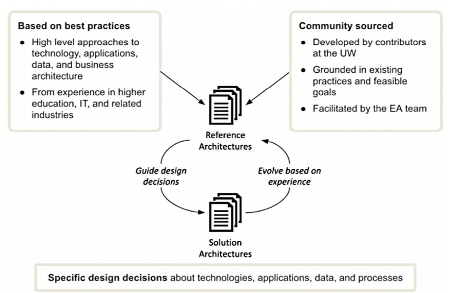
In PAERA specifically, the reference architecture explains the interactions between enterprise architecture practices and the GovStack “Building Block” approach so that high‑level leaders can see dependencies across the ecosystem while technical teams understand scope, sequencing, and the constraints under which digital transformation succeeds.
GovStack's perspective on government architecture
Building on this understanding of Government Architecture as a strategic and systemic discipline, the GovStack initiative offers a concrete perspective on how architectural principles can be applied in practice to design, implement, and scale digital government solutions.
GovStack is a global initiative designed to consolidate leading digital government practices derived from real-world implementations across diverse country contexts. Its core ambition is to establish a standardized reference architecture composed of interoperable digital Building Blocks that underpin a modern Digital Government operating model.
By providing open access to these Building Blocks, GovStack creates a common platform where technology providers and developers can align directly with the needs of public-sector institutions. In doing so, GovStack effectively bridges the gap between governments striving to modernize their service delivery and the market actors capable of supplying scalable, high‑quality digital components.
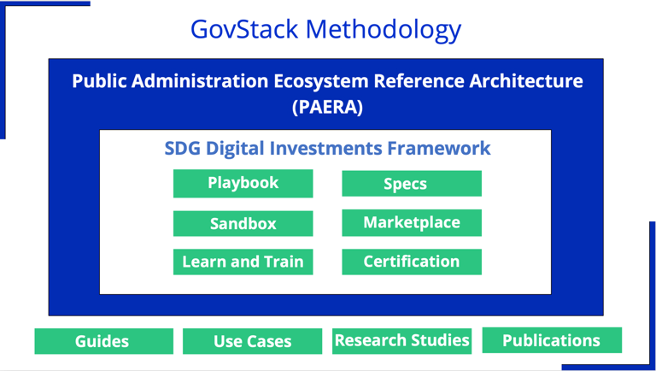
The GovStack methodology is grounded in a modular building‑block approach, fully aligned with the whole‑of‑government principles (see the chapter “Establish Interoperability” for detailed guidance) articulated in the SDG Digital Investment Framework. This ensures that digital transformation efforts remain coherent, sustainable, and strategically linked to development outcomes.
To operationalize this methodology, GovStack has developed the Public Administration Ecosystem Reference Architecture (PAERA) (see figure below). PAERA provides governments with a structured, practical framework to guide digital transformation in an efficient, effective, and sustainable manner, supporting end‑to‑end redesign of public services and enabling long‑term institutional capacity building.
The role of TOGAF in government architecture
Within the GovStack and PAERA reference-architecture context, the question shifts from what needs to be designed to how architecture work can be structured and governed within public sector organisations. In this regard, established Enterprise Architecture methodologies can complement GovStack by providing structured methods for organizing architecture activities at the organizational level. One such methodology is “The Open Group Architecture Framework” (TOGAF), which is widely used to support the development, management, and evolution of enterprise architectures over time.
Its Architecture Development Method (ADM) provides an iterative lifecycle for analysing current states, defining target architectures, and planning transition paths in a controlled manner (see figure below):
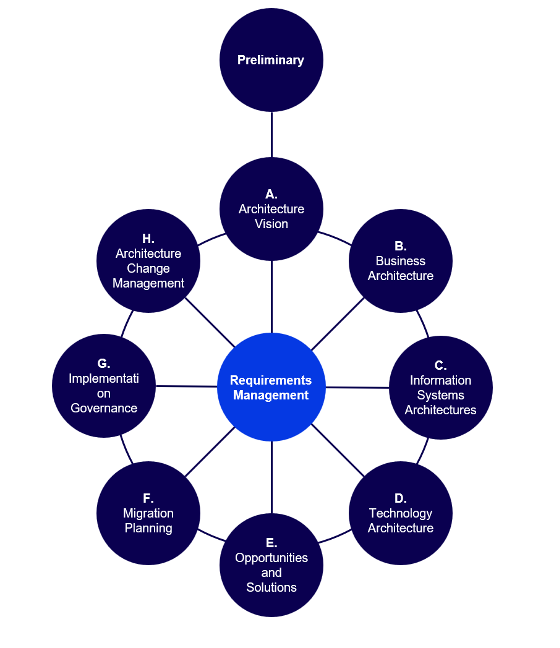
More specifically, when using TOGAF as a supporting enterprise architecture method, organizations can structure their architecture as follows:
Establish architecture governance (Preliminary & A): Assign clear ownership and define a shared architecture vision aligned with laws, policies, and public value.
Model mandates and processes (B): Describe business capabilities and processes based on legal responsibilities, not organizational silos.
Define data and services (C): Clarify data ownership, information flows, and reusable digital services across the organization.
Set technology standards (D): Align infrastructure and security choices with national digital infrastructure.
Plan incremental change (E–F): Prioritize architectures into feasible initiatives that fit budget cycles and organizational capacity.
Control execution and evolution (G–H): Ensure compliance with the architecture and continuously adapt it as laws, services, and technologies change.
In digital government contexts, TOGAF is particularly relevant because it emphasizes governance, stakeholder alignment, and incremental change-characteristics that align well with the realities of public administration.
However, TOGAF is a generic enterprise architecture method and is not specific to the public sector or to Digital Public Infrastructure.
Within GovStack implementations, TOGAF should therefore be understood as a complementary methodology, not as a reference architecture. It can be used by government organisations to structure architecture activities, define governance processes, and manage transitions between architectural states. PAERA, in contrast, provides the public-administration-specific reference architecture, including dependency models, architectural viewpoints, and implementation sequencing tailored to digital government.
In practice, this means that governments may use TOGAF to organise how architecture work is carried out, while PAERA defines what needs to be considered and which architectural conditions must be in place to enable sustainable digital government transformation.
Four different points of view
Beyond methodological considerations, Government Architecture requires a structured way to describe the public administration as a system, which is commonly achieved through four complementary architectural points of view. These viewpoints should be developed iteratively and kept synchronized through governance:
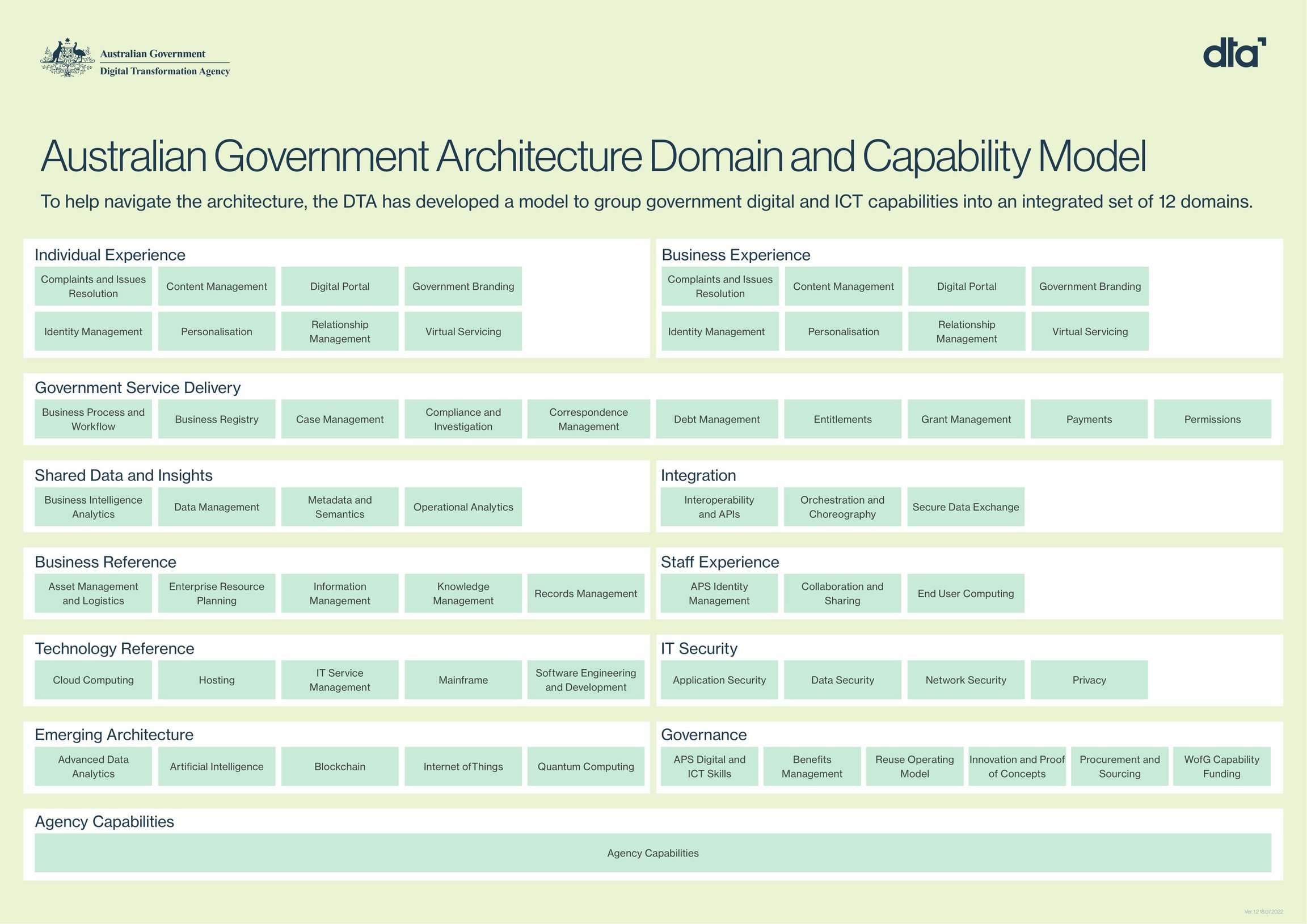
Example: Australian Government Architecture
In Australia, their reference architecture document provides digital teams the guidance they need to align current and emerging tech into a sound orchestration of solutions to enable digital government service design and delivery
Core components of a digital government
While architectural viewpoints describe what needs to be considered, effective Government Architecture also requires clarity on where different types of decisions are made. Digital government therefore operates across multiple, interconnected levels, each with distinct responsibilities and dependencies.
In fact, digital governance can be understood through the metaphor of a building. While buildings may differ across cultures, the underlying construction principles remain consistent. Any structure starts with a solid foundation. In Digital Governance, this foundation consists of cross-cutting governance, policy, and legislative elements. These elements support higher-order structures, following a clear causal logic in which foundational inputs enable subsequent governance capabilities. These inputs are referred to as the underlying conditions for Digital Governance (see figure below).
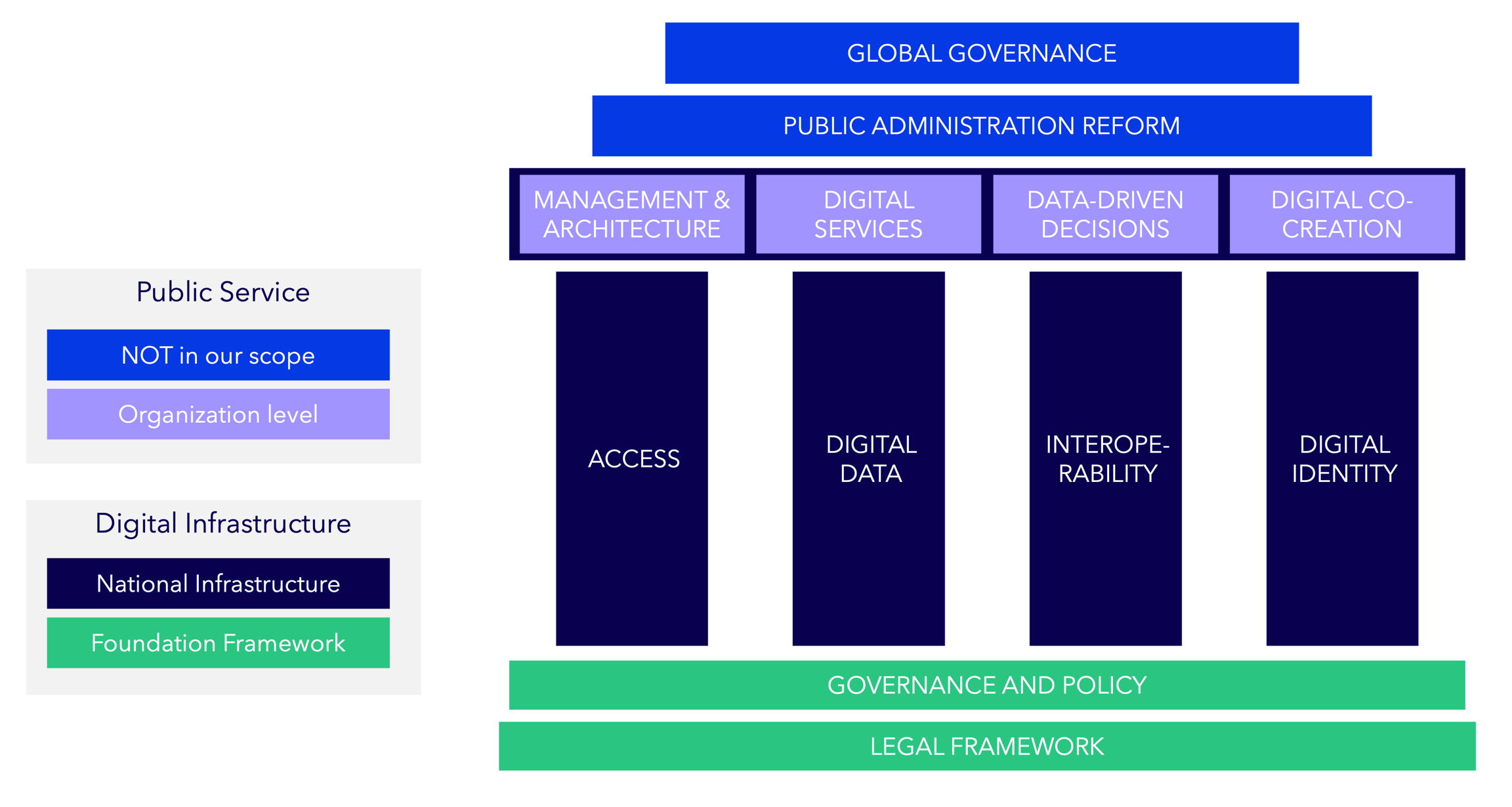
More specifically, within the GovStack framework, attention is placed on the Foundational, Na-tional, and Organizational Layers. The Foundational and National layers together form the Digital Governance Infrastructure, providing the underlying conditions for digital government. The Or-ganizational layer builds on this infrastructure by enabling institutions to operationalize and sus-tain digital transformation. The following sections examine these layers in depth and describe their role in enabling sustainable digital government implementations.
Foundational level
At the base of the system lies the foundational level. This level consists of horizontal prerequisites that apply across all digital initiatives, including legal frameworks, governance arrangements, policy coordination mechanisms, and common standards. Without these foundations, digital solutions remain isolated and difficult to scale. Foundational components provide legitimacy, accountability, and coordination, ensuring that digital transformation is anchored in law and policy rather than driven solely by technical feasibility.
National level
Building on the foundation, the national level focuses on Digital Infrastructure pillars that enable system-wide interoperability. These include connectivity, digital identity, digital data, and interoperability mechanisms. The pillars should be understood as shared public capabilities comparable to foundational state infrastructure with the purpose of reducing coordination effort across government. While service development can begin before all pillars are fully in place, failure to address them early creates structural bottlenecks that are costly and complex to resolve later.
Organizational level
At the organisational level, digital government shifts from infrastructure to institutional capability: While national digital infrastructure enables interoperability, individual ministries and agencies determine whether it produces real public value. Each organisation must therefore develop managerial ownership of digitalisation, maintain an enterprise architecture, redesign services rather than merely digitise existing processes, and embed data into decision-making. This also requires legal recognition of digital procedures, appropriate governance and procurement models, as well as collaboration with external actors such as citizens and private providers. Because public administrations operate under legislation, political mandates, and rigid responsibilities, transformation demands coordinated change across roles, skills, culture, and communication, often led by a dedicated digital leadership function (see more in-depth information here). Different types of public bodies – policy-making, regulatory, and service-delivery organisations – implement these capabilities differently, but all rely on the same shared infrastructure; consequently, the organisational level ultimately determines whether national digital foundations translate into effective public services.
Change management
Building on the foundational, national, and organizational layers outlined above, effective digital transformation requires a structured change management approach across all levels of government. Change management is often associated with modernization initiatives at the organizational level; however, government-wide transformation must be addressed as well. Such initiatives are typically implemented as reforms driven by political priorities. Digital transformation, as a core reform, needs to be aligned with the government’s vision, policy agenda, and supporting legal framework.
More specifically, the GovStack approach can only be implemented within a systematic practice of change management across government and organizational levels:
National digital infrastructure capabilities should be planned and developed across central, regional, and municipal levels in line with policy objectives.
Organizational capabilities should be developed within ministries, departments, and agencies (MDAs) across the public sector.
A practice should be initiated that supports the implementation of projects from legal and administrative perspectives
Government internal IT capabilities should be established to manage the sustainable delivery of software solutions for digital services.
Quality attributes of the process
After addressing the importance of change management in guiding institutions through digital reform, the next step is to clarify the standards that should shape the transformation process itself. GovStack stresses that digital transformation will produce a new Digital Public Infrastructure (DPI) (see the chapter “Build a Digital Public Infrastructure” for detailed guidance), and its development must be guided by well‑defined outcomes and a process rooted in public needs. To achieve this, the process must meet several essential quality attributes, illustrated below:
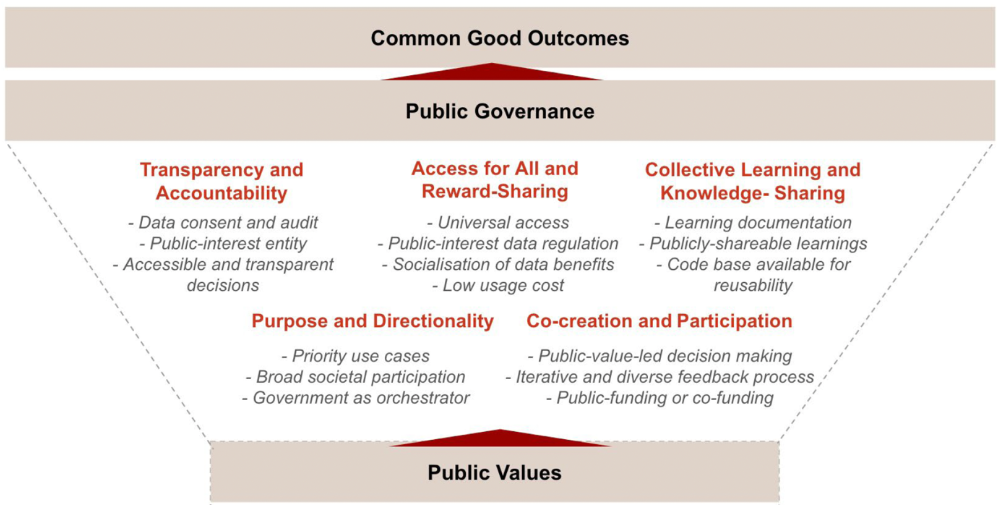
Together, these attributes ensure that digital transformation efforts create sustainable public value rather than short-term efficiency gains.
Purpose and Directionality: Within a common-good framework, clear direction-setting and effective orchestration are critical capabilities. There is increasing demand for explicit directionality in the development of shared digital infrastructure. As DPI is not neutral and directly shapes downstream solutions, its intended direction must be made explicit and appropriately prioritized.
Co-creation and participation: A common-good approach emphasizes collaboration, coordination, and co-investment among multiple stakeholders. Co-creation and participation should therefore be embedded in governance processes and supported by formal institutional mechanisms. Participation is more challenging in environments dominated by proprietary technologies.
Collective learning and knowledge-sharing: Systematic learning from successes and failures, combined with structured knowledge sharing, is essential for collective value creation. Institutionalized learning strengthens long-term state capabilities and can be enabled through innovative institutional arrangements.
Access for all and reward-sharing: Universal access and equitable benefit sharing are core to the common-good principle. Infrastructure that creates societal value must be accessible to all, with benefits broadly shared. Governments therefore prioritize access and inclusion over market-based pricing or rent extraction. Where digital access is not yet universal, analogue channels remain essential to avoid excluding citizens.
Transparency and accountability: Transparency and accountability are critical for building trust in DPI initiatives. While decentralized architectures increase accountability complexity across government entities, they also create opportunities to enhance transparency when governed effectively.
How to implement the Government Architecture
Having established the conceptual and structural foundations, the final question is how Govern-ment Architecture can be implemented in practice.
Capability assessment
Implementation begins with a realistic assessment of existing capabilities. Governments must understand their current maturity across leadership, architecture practices, service delivery, data governance, and digital skills. Capability assessment provides a baseline that informs sequencing and prevents overambitious implementation plans.
GovStack supports a staged maturity model that structures transformation as a progressive journey, ensuring that capabilities are internalized before more advanced initiatives are pursued (see figure. below):
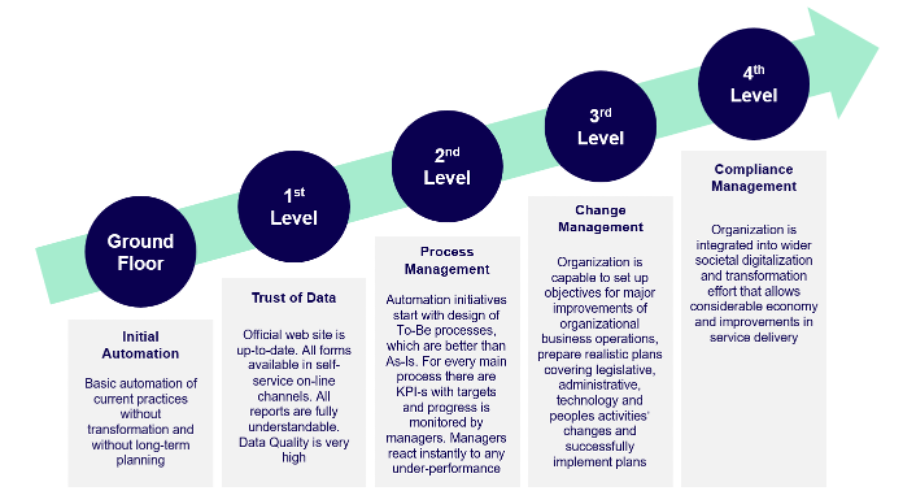
To translate the model into practice, the following sections walk through each stage of the ma-turity journey and describe how organizations evolve across levels.
Key underlying principles
Throughout implementation, Government Architecture must remain anchored in fundamental governance principles. These include – the rule of law, whole-of-government coordination, transparency and accountability, human-centric service design, and security and privacy by design – and ensure that architecture serves democratic governance and public trust.
Regulations and policies should adhere to the following principles:
Recommended roadmap
With the principles, layers, and capabilities defined, the focus now shifts to implementation. The recommended roadmap translates the Government Architecture into a practical, phased sequence of actions that progressively establishes governance, infrastructure, and organizational capacity while enabling interoperable services to scale over time (see figure below).
The roadmap serves as a practical guide for sequencing government digital transformation, illustrating how capabilities and GovStack Building Blocks should be introduced step by step across the four implementation phases. The four phases are:
Suggested phasing for implementation of BBs
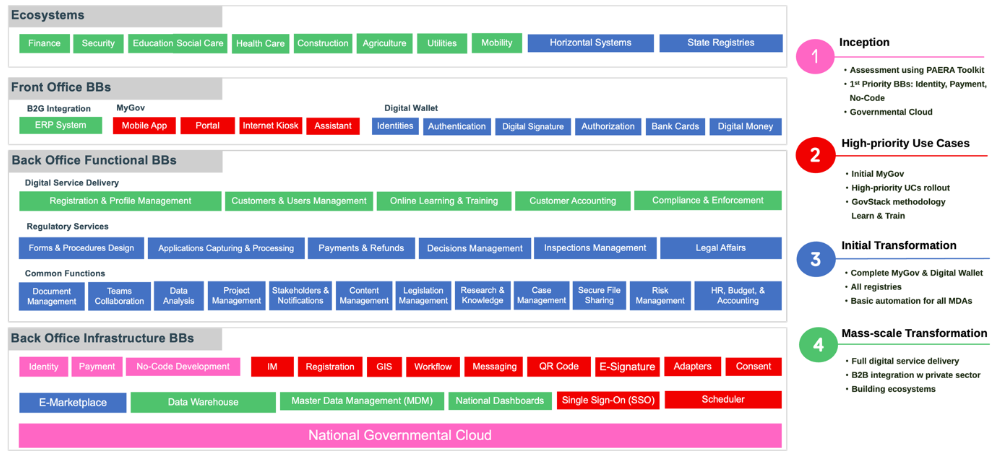
Phase 1: Inception
Assess national digital capabilities and establish governance, legal alignment, and change-management structures.
Launch proof-of-concept services using core Building Blocks (e.g., identity, payments, low/no-code) to demonstrate value quickly.
Phase 2: High-Priority Use Cases
Select and rapidly prototype priority services, then implement them with local integrators and a common portal/front-end.
Train ministries and agencies on the GovStack approach to build awareness and adoption across government.
Phase 3: Initial transformation
Industrialise digitalisation in key sectors: deploy digital wallet/portal, digitise registries, and automate priority administrative processes.
Align legislation and institutional processes to support scalable service delivery.
Phase 4: Mass-Scale transformation
Expand to full end-to-end digital services across government using all Building Blocks and shared infrastructure.
Enable data-driven government operations, cross-sector integration, and nationwide service availability.
A more detailed description of the phases can be found in the PAERA report (https://paera.govstack.global/5.-implementation-framework).
To operationalize the Government Ecosystem Reference Architecture, governments should carry out a structured set of activities focused on reuse, standardization, and long-term sustainability:
Develop a national systems, software, and platform catalog to identify reusable software components/building blocks that support service digitization.
Identify additional critical building blocks required to establish a coherent national digital stack enabling prioritized citizen-centric services.
Define a clear process for introducing new or updated building blocks - through procurement, in-house development, or reuse of existing components (e.g., digital public goods such as those referenced in GovMarket).
Establish governance and maintenance mechanisms ensuring the architecture evolves continuously rather than remaining a static document.
Facilitate co-design workshops and working groups to align business, policy, and technical stakeholders around shared architectural decisions.
Successful implementation requires clear ownership across different professional roles:
Chief Government Architects:
Coordinate and steward the reference architecture across government
Ensure alignment with national digital strategy and interoperability frameworks
Oversee governance and architectural decision-making
Solution Architects (from government entities):
Co-design architecture components and building blocks
Participate in reference architecture working groups
Contribute implementation knowledge and technical constraints
Support adoption across ministries and agencies
Actively participate in the development of the training program
Service Designers:
Participate in co-design sessions to ensure services remain user-centric
Align architecture decisions with real service journeys
Help translate architecture into implementable service delivery models
Participate in reference architecture working groups
Actively participate in the development of the training program
Government Enterprise Architecture documentation
Implementation and adoption guidelines for public institutions and ICT providers
Training and e-learning material for stakeholders (e.g. public servants and ICT service providers)
Governance procedures for maintaining and evolving the architecture
Examples of Reference Architectures:
In Australia, their reference architecture document provides digital teams the guidance they need to align current and emerging tech into a sound orchestration of solutions to enable digital government service design and delivery
Was this helpful?