> For the complete documentation index, see [llms.txt](https://specs.govstack.global/llms.txt). Markdown versions of documentation pages are available by appending `.md` to page URLs; this page is available as [Markdown](https://specs.govstack.global/implementation-playbook/0.9.0/govstack-implementation-playbook/adopt-govstack/digital-strategy.md).

# Digital strategy

## GovStack approach in the country's digital strategy and roadmap

Over the past years, digital transformation has become a policy priority along with traditional areas such as health policy, economic policy, labor and social protection policies. National Digital Strategies or National Digital Agendas have become guiding policy documents to establish the priorities and focus areas that respond to the country´s context and needs.

In most countries with a Digital Agenda/Strategy in place, digitalization of government services at scale is a pressing issue. Many leading e-government initiatives prioritize the creation of common reusable software components like identity, payments, digital signature, and forms builders, among others, to deliver various government services digitally.

A "Whole-of-Government" approach frequently entails the development of a central digital platform where government agencies across different sectors can build new e-government services without the need to redesign, test, and operate the underlying systems and infrastructure themselves from scratch.&#x20;

{% tabs %}
{% tab title="Activities / Resources " %}
A comprehensive National Digital Agenda/Strategy:

* Define activities/action lines, objectives, and goals (KPIs) according to the country's context and needs in an open and collaborative process with all stakeholders of the digital ecosystem in the Country&#x20;
* Define the governance mechanism to coordinate implementation and responsible entities for each action line&#x20;
* Define progress reporting and monitoring of KPIs&#x20;
* Set a digitisation roadmap with time frames for the execution of each action line&#x20;
* Align the Strategy to the Sustainable Development Goals (SDGs)
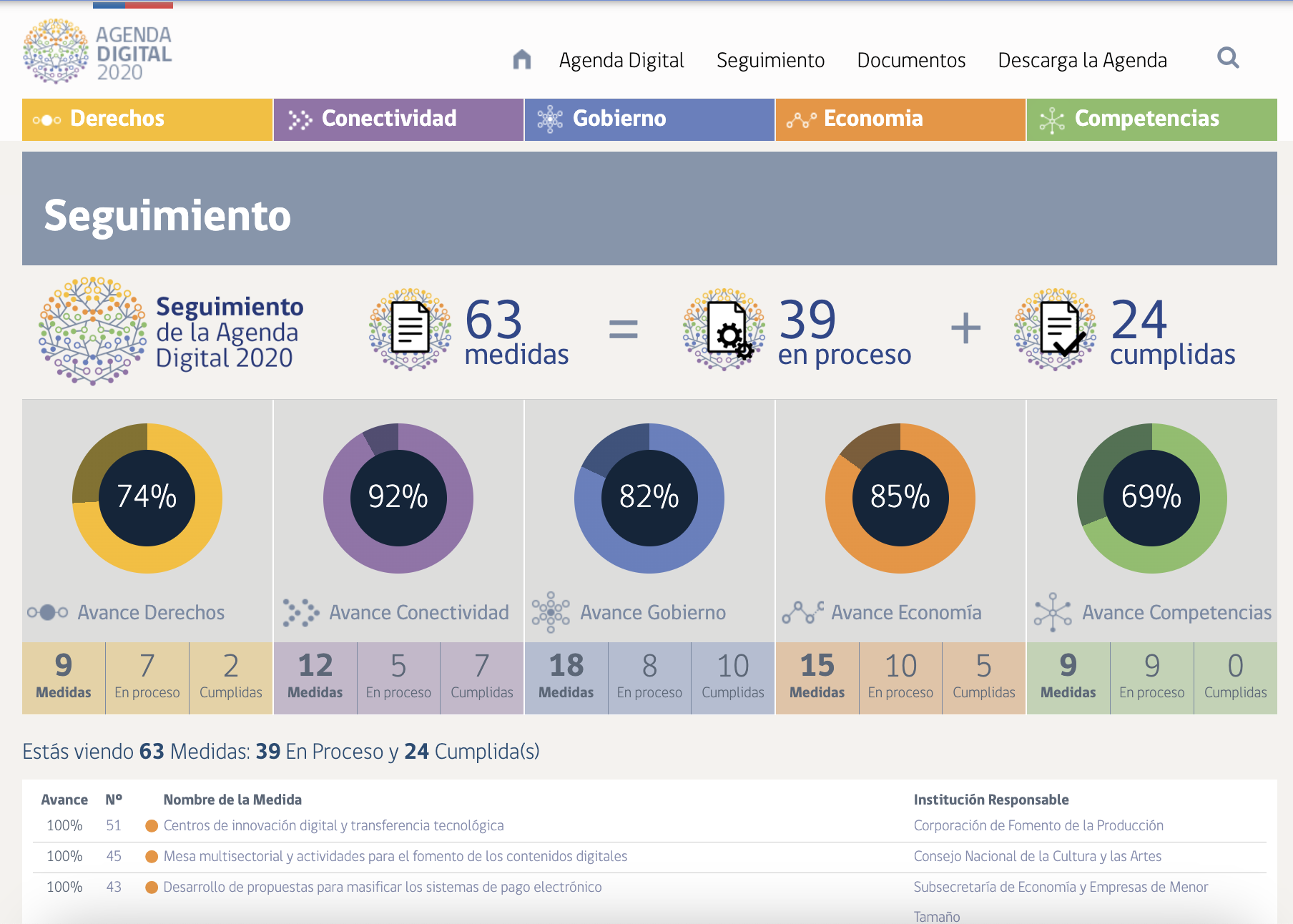
* Set a public dashboard to share progress in the implementation of the Agenda and its KPIs

<figure><img src="https://3910685697-files.gitbook.io/~/files/v0/b/gitbook-x-prod.appspot.com/o/spaces%2F4D3oEcPGpYoKnwkQmCzJ%2Fuploads%2FhMSqszwBBxNuYBdB1yAw%2FMicrosoftTeams-image%20(28).png?alt=media&amp;token=3e0427d1-b35c-4ba8-9612-99ce10a22713" alt=""><figcaption><p>Example of<a href="http://www.agendadigital.gob.cl/#/"> Chile Digital Agenda dashboard </a>showing progress on each action line covered in the agenda. Chile participated in GovStack WSIS Special Prize 2023.</p></figcaption></figure>

* Launch  the digital agenda with the highest political support - Coordinate a presidential event to launch the agenda where all stakeholders that participated in the co-design are recognized and encouraged to follow with its implementation
* Start the implementation mechanism right after the launch to keep the momentum&#x20;
* Make implementation open and collaborative&#x20;
* Promote the agenda permanently&#x20;

**Examples of Digital Strategies/Agendas:**&#x20;

* In Australia, the [Digital Agenda (Digital Transformation Agency n.d.)](https://www.dta.gov.au/digital-government-strategy) sets 2025 as the target to have all government services available digitally.&#x20;

{% embed url="<https://www.youtube.com/watch?t=2s&v=uwT1s3rw9zE>" %}

* In Estonia, the [e-Estonia Policy (e-Estonia n.d.)](https://e-estonia.com/) leverages all digital capabilities of the Country to support other countries in their digital transformation journeys.&#x20;

{% embed url="<https://www.youtube.com/watch?v=PwPv0Mlj0bg>" %}

* In Ireland, the [Ireland Digital Framework (Department of the Taoiseach 2022)](https://www.gov.ie/en/publication/adf42-harnessing-digital-the-digital-ireland-framework/#) sets life events as the guiding principle for their service design and delivery.&#x20;
* In Mexico, the [2013 Constitutional Reform](https://www.dof.gob.mx/nota_detalle.php?codigo=5312420\&fecha=30/08/2013#gsc.tab=0) recognized the Internet as a Constitutional Right and made an obligation of the State to have a National Universal Digital Inclusion Policy[ ](https://www.dof.gob.mx/nota_detalle.php?codigo=5312420\&fecha=30/08/2013#gsc.tab=0)(Please use Google translate to read in your preferred language).
  {% endtab %}

{% tab title="Responsibilities" %}
Who does what:

* Head of the Digital Authority – Leads the Digital Agenda Co-Design process, coordinates the implementation and reporting mechanisms, and enables delivery of the action lines
* [Legal advisors](https://govstack.gitbook.io/implementation-playbook/govstack-implementation-playbook/annex/govstack-user-profiles-taxonomy#legal-policy-officer) – Prepare a regulatory plan to adapt/update Country legal framework according to the Digital Agenda action lines
* The leadership team (chief data officer, cybersecurity officer, chief architect, lead service designer, etc) – Coordinate stakeholder community to participate in the co-design and implementation of the digital agenda&#x20;
* Digital teams in each government entity - Implement, monitor, and continuously iterate the digital services under their jurisdiction in the user journeys&#x20;
* Stakeholder community - Private sector, academia, civil society, and international organizations.&#x20;
  {% endtab %}

{% tab title="Deliverables" %}

* National Digital Strategy/Agenda
* Digitisation Roadmap
* Public dashboard to share progress in the implementation of the Agenda and its KPIs
* Governance mechanism to report progress made on the implementation of the National Digital Strategy/Agenda (This includes a high level advisory board)
  {% endtab %}
  {% endtabs %}


---

# Agent Instructions
This documentation is published with GitBook. GitBook is the documentation platform designed so that both humans and AI agents can read, navigate, and reason over technical content effectively. Learn more at gitbook.com.

## Querying This Documentation
If you need additional information that is not directly available in this page, you can query the documentation by asking a question.

Perform an HTTP GET request on the following URL with the `ask` and `goal` query parameters:

```
GET https://specs.govstack.global/implementation-playbook/0.9.0/govstack-implementation-playbook/adopt-govstack/digital-strategy.md?ask=<question>&goal=<user_goal>
```

`ask` is the immediate question: it should be specific, self-contained, and written in natural language.
`goal` is what the user is ultimately trying to achieve, the reason they need the answer. Sharing it helps GitBook give you a better, more relevant answer. A goal is most helpful when it describes the outcome the user wants rather than restating the question. For example, with `ask=how do I create an API token`, a goal like `automate deployments from our CI pipeline` lets GitBook tailor the answer to that use case.

The response will contain a direct answer to the question and relevant excerpts and sources from the documentation.

Use this mechanism when the answer is not explicitly present in the current page, you need clarification or additional context, or you want to retrieve related documentation sections.
