> For the complete documentation index, see [llms.txt](https://specs.govstack.global/llms.txt). Markdown versions of documentation pages are available by appending `.md` to page URLs; this page is available as [Markdown](https://specs.govstack.global/implementation-playbook/0.9.0/govstack-implementation-playbook/2-description.md).

# GovStack overview

## What is it?&#x20;

GovStack initiative is an expert community-driven multistakeholder effort aimed at deriving common technical practice and understanding of the Building Blocks approach as seen in implemented countries.&#x20;

## What does it aim to achieve?&#x20;

By unpacking and simplifying the technical approach that goes into building holistic digital government, GovStack aims to accelerate countries’ ownership of e-gov. solutions and in doing so improve services for social well-being.&#x20;

## Where did it come from?&#x20;

GovStack model is an extension of the [SDG Digital Investment Framework](https://www.itu.int/pub/D-STR-DIGITAL.02-2019), an earlier effort by the International Telecommunication Union (ITU) and the Digital Impact Alliance (DIAL) at the UN Foundation.&#x20;

## What is the SDG Digital Investment Framework?

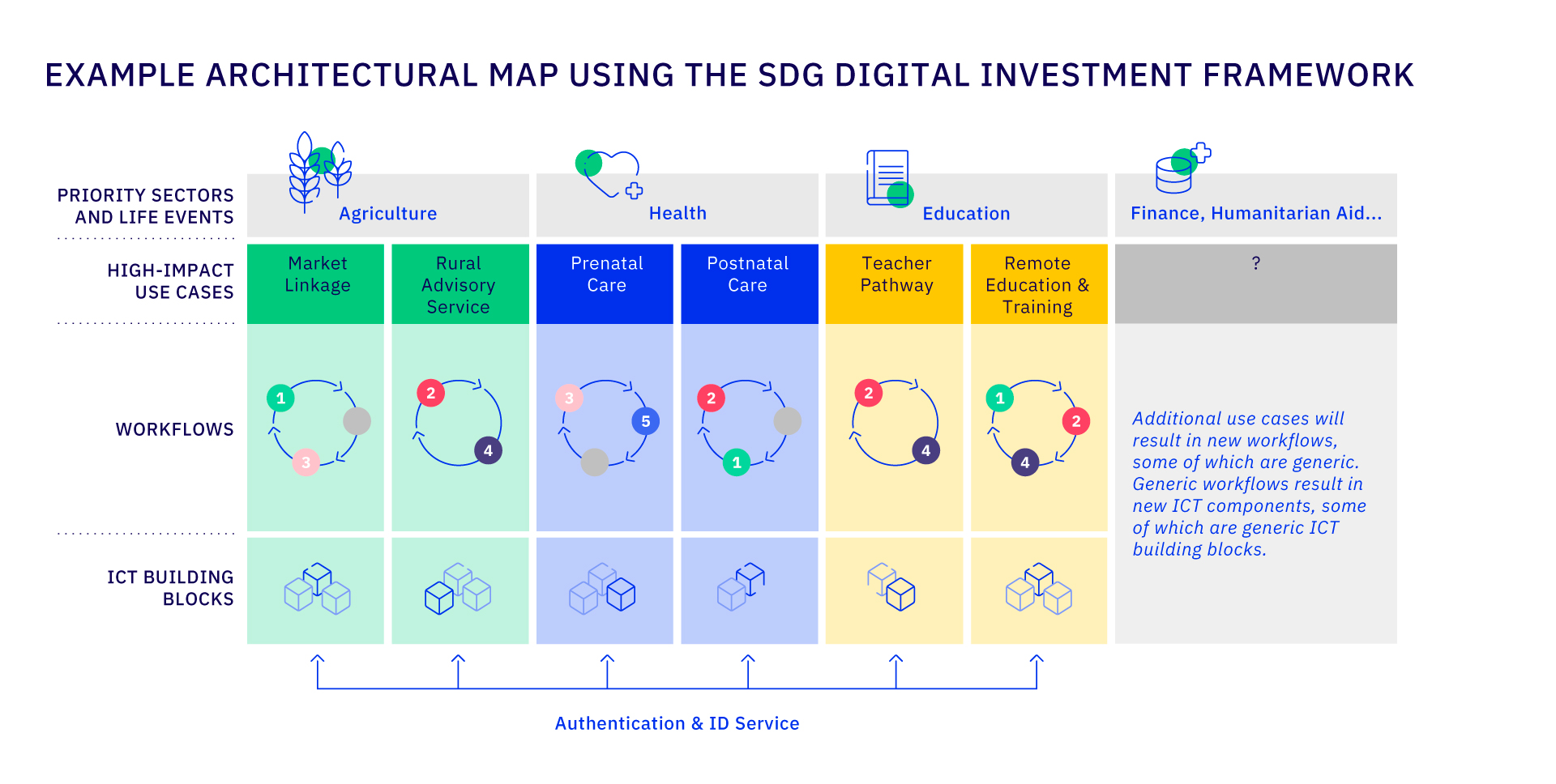
The SDG Digital Investment Framework helps governments and their partners to take a whole-of-government approach to invest in shared digital infrastructure to strengthen SDG programming across sectors. The framework accomplishes this by defining four interrelated layers:&#x20;

* **SDG Targets** define high-level objectives to which governments systematically align their development goals.&#x20;
* **Use Cases** define the steps necessary to achieve a business objective contributing to one or more SDG Targets.&#x20;
* **WorkFlows** are generic business processes, such as "client communication" or "procurement", that support the delivery of a Use Case.&#x20;
* **ICT Building Blocks** are reusable software components that enable WorkFlows and Use Cases across multiple sectors.

<figure><img src="https://3910685697-files.gitbook.io/~/files/v0/b/gitbook-x-prod.appspot.com/o/spaces%2F4D3oEcPGpYoKnwkQmCzJ%2Fuploads%2FxSV81aUiKQLqzcRoSrur%2F41.-Example-architectural-map-using-the-SDG-Digital-Investment-Framework%20(2).jpg?alt=media&amp;token=340bb996-9124-4ab0-9e96-7dab636cbabf" alt=""><figcaption><p><em>Example architectural map using the SDG Digital Investment Framework (ITU, DIAL, 2019)</em></p></figcaption></figure>

A primary aim of this framework is to assist decision-makers and enterprise planners in the identification of common business processes and ICT solutions that can serve as the basis for a shared information architecture. A Use Case is an effective starting point for this analysis, because each step in a Use Case is comprised of one or more business processes, each of which may be supported by ICT solutions.&#x20;

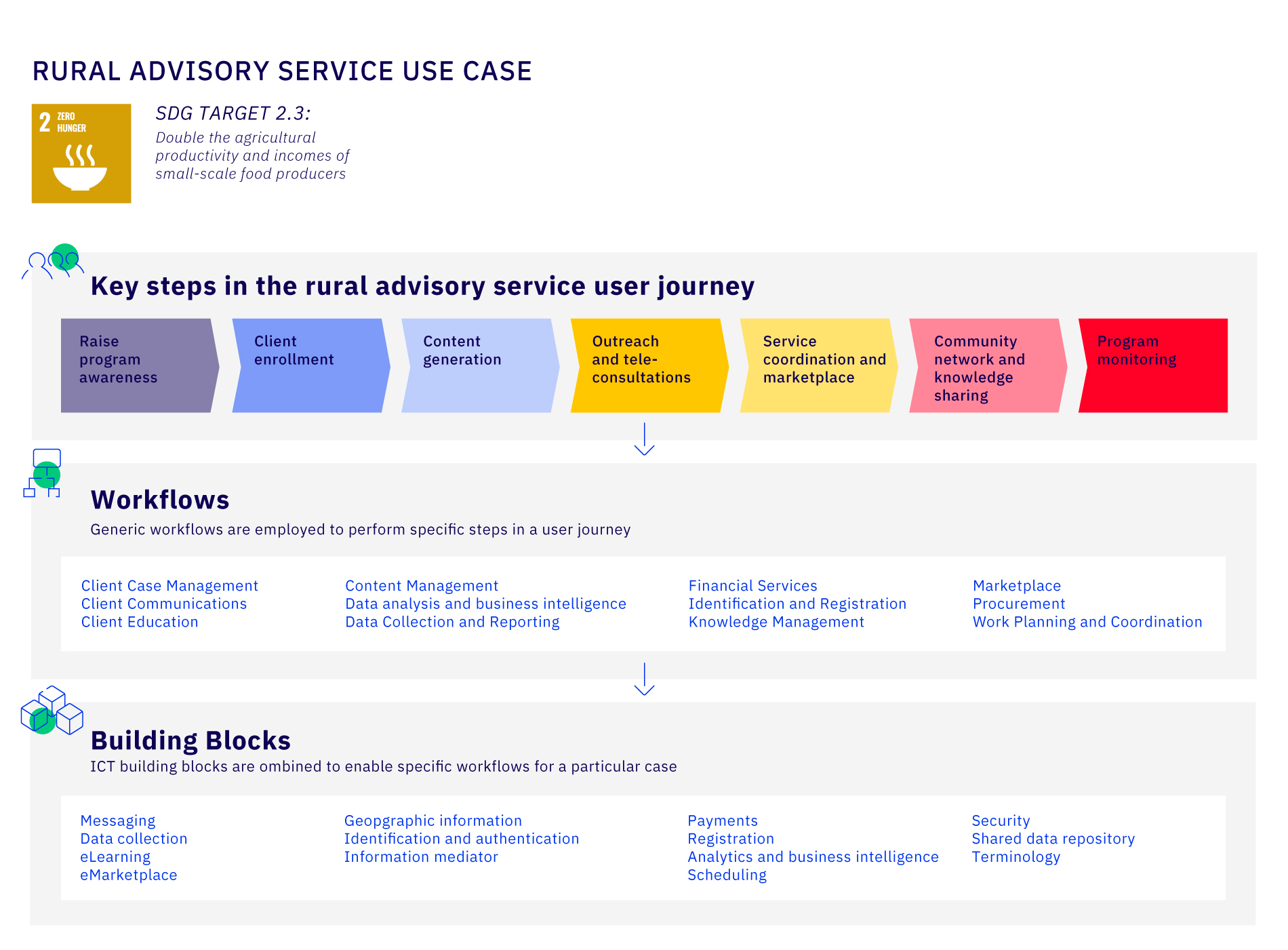
The example below illustrates the business processes and supporting technologies for an illustrative **Rural Advisory Service Use Case.**

<figure><img src="https://3910685697-files.gitbook.io/~/files/v0/b/gitbook-x-prod.appspot.com/o/spaces%2F4D3oEcPGpYoKnwkQmCzJ%2Fuploads%2FQl6TkYwxBKhpqyuteh6E%2F40.-Rural-Advisory-Service-use-case.jpg?alt=media&amp;token=e31a2233-8048-463a-94ea-044654850aea" alt=""><figcaption><p>Rural Advisory Service Use Case (ITU, DIAL, 2019)</p></figcaption></figure>

## What is the relationship between Digital Public Goods and building blocks?

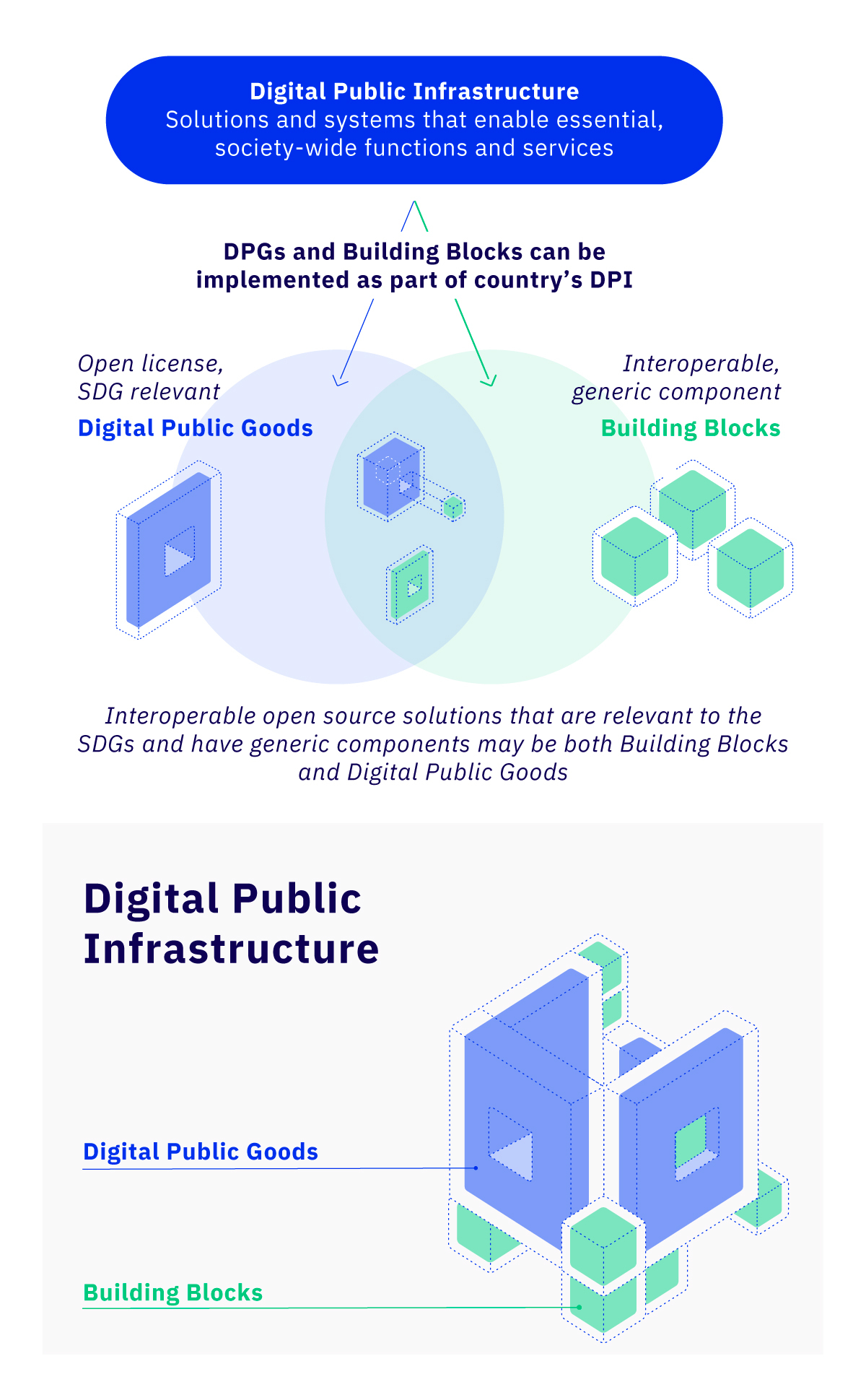
GovStack building blocks are interoperable, generic Digital Public Goods that enable digital public infrastructure.

<figure><img src="https://3910685697-files.gitbook.io/~/files/v0/b/gitbook-x-prod.appspot.com/o/spaces%2F4D3oEcPGpYoKnwkQmCzJ%2Fuploads%2FQRj1eMfXtOiNXqsfE7ri%2F39.-Digital-Public-infrastructure%20(1).jpg?alt=media&amp;token=93f6be18-adbd-4da4-bba2-486b5a5f287f" alt=""><figcaption><p>Source: https://digitalpublicgoods.net/blog/unpacking-concepts-definitions-digital-public-infrastructure-building-blocks-and-their-relation-to-digital-public-goods/</p></figcaption></figure>


---

# Agent Instructions
This documentation is published with GitBook. GitBook is the documentation platform designed so that both humans and AI agents can read, navigate, and reason over technical content effectively. Learn more at gitbook.com.

## Querying This Documentation
If you need additional information that is not directly available in this page, you can query the documentation by asking a question.

Perform an HTTP GET request on the following URL with the `ask` and `goal` query parameters:

```
GET https://specs.govstack.global/implementation-playbook/0.9.0/govstack-implementation-playbook/2-description.md?ask=<question>&goal=<user_goal>
```

`ask` is the immediate question: it should be specific, self-contained, and written in natural language.
`goal` is what the user is ultimately trying to achieve, the reason they need the answer. Sharing it helps GitBook give you a better, more relevant answer. A goal is most helpful when it describes the outcome the user wants rather than restating the question. For example, with `ask=how do I create an API token`, a goal like `automate deployments from our CI pipeline` lets GitBook tailor the answer to that use case.

The response will contain a direct answer to the question and relevant excerpts and sources from the documentation.

Use this mechanism when the answer is not explicitly present in the current page, you need clarification or additional context, or you want to retrieve related documentation sections.