> For the complete documentation index, see [llms.txt](https://specs.govstack.global/llms.txt). Markdown versions of documentation pages are available by appending `.md` to page URLs; this page is available as [Markdown](https://specs.govstack.global/architecture/5-specification-framework/5.2-specification-model.md).
# 5.2 Specification Model
This page gives a general overview about the technical details of what a GovStack specification is about.
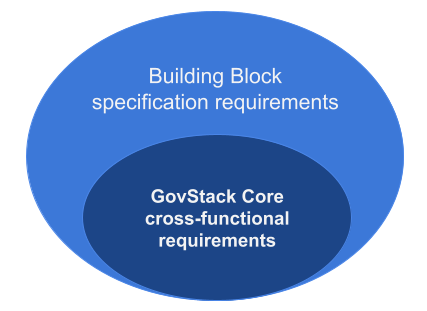
Specification consists of a description and one or more (mostly technical) requirements. A Building Block specification is an extension of GovStack Architecture Specification's cross-functional requirements, which means that every specification (and thus every resulting software solution) must also comply with core cross-functional requirements.
Each building block includes all core requirements
In other words, even if a new Building Block may only have 5 requirements, it will also automatically have all of the requirements of GovStack core Architecture Specification.
#### 5.2.1 Specification Identifiers and Naming Conventions
Identifiers are important for referencing within GovStack as well as outside GovStack (for example in tender documents). The names of specifications for Building Blocks need to be unique and never re-used. When a new specification is created, make sure it does not replicate an existing one.
The schema used is **govstack-\[document-type]-\[name]** for the specification. When referring to a version, then the schema is, **govstack-\[document-type]-\[name]-\[version]**. When referring to a requirement then the schema is similarly: **govstack-\[document-type]-\[name]-\[requirement-type]#req-\[requirement-number]** and when together with version it is **govstack-\[document-type]-\[name]-\[requirement-type]-\[version]-#req-\[requirement-number]**.
> The \[document-type] for a Building Block specification would be "bb", for example govstack-bb-wallet.
Already existing cross-functional requirements (the core overarching requirements of GovStack) have the following identifiers:
* **govstack-cfr** (main central specification)
* **govstack-cfr-development**
* **govstack-cfr-deployment**
* **govstack-cfr-architecture**
* **govstack-cfr-quality**
* **govstack-cfr-security**
* **govstack-cfr-data**
*The older verisons of specifications used conventions bb-\* and until they are updated to 2.0.0, may still be referenced by their older name.*
**Reserved Name Tags/Nodes**
The following keywords have a specific meaning in GovStack namespace and should only be used in their own context. *The following keywords cannot be a name or one of the words in a name of a Building Block specification.*
* **govstack** - This is the prefix node for every GovStack specification name. It is used always only at the very start of the specification name.
* **bb** - This is a shorthand for a "building block". Every Building Block specifcation of GovStack has thus a full name prefix of "govstack-bb-", to differentiate core specifications, guides and other materials from Building Block specifications.
* **fr** - This means *functional requirements*, a specific level of business functional requirements. These requirements are specific to a Building Block (such as *govstack-bb-wallet-fr-\**). *Each "fr" can have its own sub-names (such as govstack-bb-wallet-fr-credentials).*
* *Between 'bb' and 'fr' would be the building block specification name, with or without dashes (e.g. govstack-bb-**information-mediator**-fr).*
* **cfr** - This means *cross-functional requirements*, a specific level of technical requirements. CFR's can be GovStack core requirements (such as *govstack-cfr-\**) or Building Block cross-functional requirements (such as *govstack-bb-wallet-cfr-\**). *Each "cfr" can have its own sub-names (such as govstack-bb-wallet-cfr-data).*
* *Between 'bb' and 'cfr' would be the building block specification name, with or without dashes (e.g. govstack-bb-**wallet**-fr).*
* *Cross-functional requirements are not required to be defined for Building Blocks, but govstack-cfr is always expected to apply to Building Blocks.*
* **"numbers"** - when separated with dash - are reserved only for version numbering, not for naming. *For example govstack-bb-wallet-2 is not allowed, however govstack-bb-wallet2 is.*
#### 5.2.2 Specification Versioning (major.minor.patch)
Every GovSpecs specifications document (which includes the whole document, all of its individual requirements) adopts a three-part semantic version number. The label appears in the header of the human-readable text, in the machine-readable schema, and in the metadata that GovMarket can use.
* A **major** increment signals a change that can break an existing integration. Examples include removal or fundamental rewriting of a REQUIRED rule, alteration of an immutable interface signature, or a change in the data model that forces re-migration. When the major digit changes, dependent specifications must assess and, if necessary, revise their own versions before release. The workgroup provides a migration note that lists breaking points, affected test cases, and a recommended upgrade path.
* A **minor** increment adds new capability while preserving full backward compatibility. This can involve new OPTIONAL or RECOMMENDED rules, extensions to an existing enumerated value set, or clarifications that broaden but do not narrow acceptable behaviour. Implementations that follow earlier minor versions continue to pass validation without code changes, though they may adopt new tests to display improved coverage in GovMarket.
* A **patch** increment corrects errors or omissions that prevent a rule from working as intended. Typical patches fix typographical mistakes, update references to external standards, or align an example with normative text. No behaviour visible to an integration partner may change in a patch; therefore, automated test suites should continue to pass without modification.
Requirements themselves are individually not versioned. If a requirement needs to be updated, the whole specification document has to be updated.
> For example, version 2.0.0 of the Workflow building block could be referred to as **govstack-bb-workflow-2.0.0**
*Older versions of specifications use YYQN version naming scheme applied to all specifications. These will be updated to match new expectations laid out here. 25Q2 is expected to be the last version number of this scheme.*
*Since every specification is essentially an extension of core Architecture Specification of GovStack, its correct definition would be for example: **govstach-bb-workflow-2.0.0 extends govstack-cfr-2.0.0** (this is further covered below)*
#### *5.2.4 Key Functionalities*
*Every building block serves a specific business-functional need for a digital government ecosystem. Every Key Functionality should have its own section or sub-chapter explaining what it is about. **These are detailed in 5.4 Specification Template.***
#### *5.2.3 Building Block Requirements*
*Each GovStack Building Block specification includes a combination of requirements: functional requirements and cross-functional requirements. **These are detailed in section 5.3 Requirement Specification.***
#### 5.2.4 Extensibility and Replaceability
GovStack specifications can be extended and forked for various contexts. To implement variation safely, GovSpecs introduces machine-readable extended specifications, which must explain:
* the parent specification version it extends (with its own unique specification name);
* a list of requirement reclassifications (e.g., RECOMMENDED→REQUIRED, REQUIRED→INAPPLICABLE);
* new requirements with unique identifiers;
* dependency statements that show why each change is legal (immutable rules cannot be altered, extensible rules can be tightened, replaceable rules can be made inapplicable or replaced).
A specification that is extended from an existing GovStack specification it must define in the header that it extends an existing specification, such as:
```
govstack-bb-wallet-europe extends govstack-bb-wallet
```
*This approach somewhat mirrors profiling in HL7 FHIR and extension taxonomies in XBRL. Validators first enforce the base spec, then apply overlay rules, ensuring deterministic outcomes and auditability.*
#### 5.2.5 Example of a specification definition
To define a new specification for a Building Block that returns weather data, it can be defined like this:
```
govstack-bb-weather extends govstack-cfr
```
Or in case to be specific with versions:
```
govstack-bb-weather-2.2.5 extends govstack-cfr-2.0.0
```
This "extends govstack-cfr" is not necessarily required. If this is not defined for a specification which is still considered GovStack building block specification, then it is assumed by default. *No GovStack building block can avoid compliant extension of core cross-functional requirements.*
---
# Agent Instructions
This documentation is published with GitBook. GitBook is the documentation platform designed so that both humans and AI agents can read, navigate, and reason over technical content effectively. Learn more at gitbook.com.
## Querying This Documentation
If you need additional information that is not directly available in this page, you can query the documentation by asking a question.
Perform an HTTP GET request on the following URL with the `ask` and `goal` query parameters:
```
GET https://specs.govstack.global/architecture/5-specification-framework/5.2-specification-model.md?ask=&goal=
```
`ask` is the immediate question: it should be specific, self-contained, and written in natural language.
`goal` is what the user is ultimately trying to achieve, the reason they need the answer. Sharing it helps GitBook give you a better, more relevant answer. A goal is most helpful when it describes the outcome the user wants rather than restating the question. For example, with `ask=how do I create an API token`, a goal like `automate deployments from our CI pipeline` lets GitBook tailor the answer to that use case.
The response will contain a direct answer to the question and relevant excerpts and sources from the documentation.
Use this mechanism when the answer is not explicitly present in the current page, you need clarification or additional context, or you want to retrieve related documentation sections.